Quick Answer: What Is BrandRank.ai Visibility Insights Analysis?
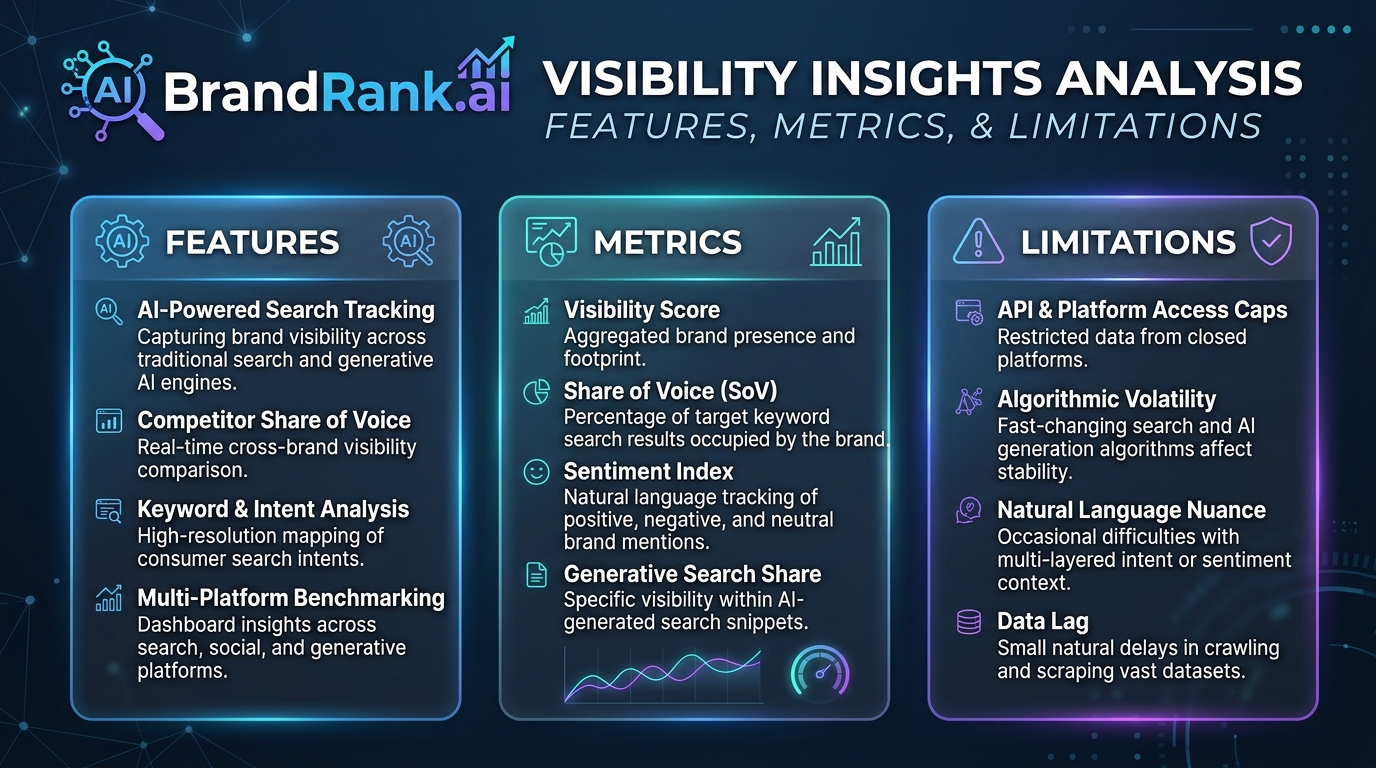
BrandRank.ai visibility insights analysis refers to examining how BrandRank.AI measures a brand’s presence, reputation, and content readiness across AI-generated answers. The platform says it monitors priority questions across seven answer engines, including ChatGPT, Google Gemini, Perplexity, Claude, Grok, Meta AI, and DeepSeek. Its main areas of analysis are AI search visibility, brand vulnerability, and content readiness. It also promotes Recommendation Share, a metric intended to show how often a brand is named as a recommendation rather than simply mentioned. These measurements can help marketing and communications teams identify gaps in AI search coverage, investigate inaccurate claims, and prioritize content improvements. However, the scores are platform-specific indicators, not guarantees of higher rankings, more sales, or consistent recommendations from every AI system.
Key Takeaways
- BrandRank.AI is an AI brand monitoring and visibility platform, according to its official website.
- Its central analysis areas include visibility, vulnerability, and content readiness.
- Recommendation Share is designed to distinguish a brand being mentioned from a brand being recommended.
- The platform advertises daily monitoring across seven answer engines and competitive benchmarking.
- Public plan descriptions are available, but the official product page does not display fixed subscription prices.
- Results should be reviewed alongside real customer questions, website analytics, search data, and manual checks.
What Is BrandRank.AI?
BrandRank.AI is a software platform designed to help organizations understand how AI answer engines describe and recommend their brands. Traditional SEO tools primarily track search rankings, impressions, clicks, backlinks, and organic traffic. BrandRank.AI focuses on a different question: when a potential customer asks an AI assistant for advice, does the answer include the brand, what does it say, and which sources support that answer?
The distinction matters because people increasingly use conversational tools to compare products, explore services, and shortlist companies. An AI-generated response may summarize several sources into one answer rather than present a familiar list of search results. A brand can have a well-designed website and still be absent from a particular response.
According to its official website, BrandRank.AI monitors priority prompts, tracks brand performance across answer engines, and presents measurements intended to help teams understand visibility, trust, and risk. Its product overview describes daily tracking, competitive benchmarking, source attribution, and content guidance.
These descriptions explain what the company offers. They do not independently establish that every recommendation improves AI visibility or produces a particular business outcome.
How BrandRank.ai Visibility Insights Analysis Works
The platform’s published approach starts with the questions people may ask about a brand or its product category. These prompts can include general category searches, product comparisons, “best” questions, and brand-specific queries.
BrandRank.AI says it tests priority prompts, captures AI-generated responses, examines citations, and analyzes where a brand appears. It then organizes findings into scores and monitoring reports.
A practical workflow looks like this:
- Define priority questions. Identify the questions customers ask before choosing a product or service.
- Monitor answer engines. Review how selected AI platforms respond to those questions.
- Check brand mentions. Record whether the brand appears, how it is described, and whether it is recommended.
- Inspect the evidence. Review available citations and the claims associated with the answer.
- Identify gaps. Look for missing information, inconsistent descriptions, weak supporting sources, or competitor visibility.
- Prioritize improvements. Update relevant pages, product details, FAQs, and supporting evidence.
- Repeat the checks. Monitor later results to see whether the same issues persist or change.
This process can turn a vague concern about AI visibility into a list of questions that a marketing team can investigate. It does not mean the platform controls the underlying AI systems. Their responses can change as models, sources, prompts, and retrieval methods change.
The Main Metrics Explained
1. AI Search Visibility
Visibility measures whether and how prominently a brand appears in responses to selected prompts. A company might appear in an answer to a broad category question but disappear when the user asks for a comparison, a specific use case, or a recommendation for a particular budget.
That is why one overall score may not tell the whole story. A useful review should examine visibility by prompt, platform, product category, and time period wherever those breakdowns are available.
For example, a project management brand might appear when an AI assistant lists popular project management platforms but remain absent from questions about tools for small nonprofit teams. The second result points to a more specific coverage gap than a general statement that the brand has low visibility.
A visibility score should be treated as a monitoring indicator. It does not automatically represent market share, brand awareness among all consumers, or the total number of people who have seen a brand.
2. Brand Vulnerability
Brand vulnerability focuses on risks in the way AI systems describe a company or its products. These may include outdated details, inaccurate statements, omissions, inconsistent claims, or situations where a competitor is presented more favorably.
This area is particularly relevant to companies with complex product ranges, frequently updated services, or information spread across many websites. A retired product feature, an old policy, or a misleading third-party page can complicate the picture that a customer receives.
BrandRank.AI describes a Brand Risk Monitor that watches AI answers for potentially harmful claims. Before relying on any alert, a team should inspect the original answer, the prompt that produced it, the date, and the cited source when available.
A flagged statement is not automatically proof that an AI platform has made a factual error. The context matters. A response may be incomplete rather than false, or it may accurately describe an older policy that the company has since changed. Human review is necessary before making corrections or public statements.
3. AI Content Readiness
Content readiness concerns whether information about a brand is accessible, clear, detailed, and structured well enough for AI systems to interpret. BrandRank.AI describes factors such as content accessibility, depth, schema, and what it calls content liquidity.
In practical terms, a company should make essential facts easy to locate. Product pages should state what a product does, who it serves, its limitations, and its current specifications. Help pages should answer real customer questions directly. Organization names, product details, prices, and policies should remain consistent across relevant pages.
Structured data may help search systems interpret information, but adding schema does not guarantee an AI citation. Likewise, publishing more content is not necessarily useful if it repeats existing material without adding reliable evidence.
Readiness is best approached as a content quality and accessibility review, rather than a secret formula for forcing AI systems to recommend a brand.
4. Recommendation Share
BrandRank.AI promotes Recommendation Share as a way to measure how often a brand is selected or named as a recommendation in AI answers. This is distinct from a simple mention.
For example, an answer might list a company among several providers without recommending it. Another answer might identify that company as a suitable choice for a specific customer need. Those outcomes are different, even if both contain the brand name.
When assessing this metric, teams should ask how the platform defines a recommendation, which prompts are included, how results are scored, and whether the same methodology is used across competitors and reporting periods. These details matter because changes in prompt selection can influence the result.
Recommendation Share should not be confused with conversion rate or actual customer preference. It measures a defined set of AI responses, not every buying decision in the market.
BrandRank.AI Features at a Glance
| Feature | What it is intended to show | Why it may be useful |
|---|---|---|
| AI visibility tracking | Whether a brand appears in selected AI answers | Reveals prompt-level coverage gaps |
| Brand vulnerability monitoring | Potentially inaccurate, risky, or inconsistent claims | Helps teams investigate reputation risks |
| Content readiness analysis | Whether brand information is accessible and well structured | Guides website content improvements |
| Recommendation Share | How often a brand is named as a recommendation | Adds context beyond basic mentions |
| Competitive benchmarking | How a brand appears compared with selected competitors | Identifies areas where competitors are more visible |
| Source attribution | Sources associated with AI-generated answers | Helps teams investigate claims and citation gaps |
| Multi-brand reporting | Monitoring across several brands or markets, depending on plan | Supports larger marketing teams |
These are descriptions of the platform’s advertised capabilities, not independent test results. The availability and depth of each feature may depend on the selected plan and implementation.
Which AI Platforms Does BrandRank.AI Monitor?
BrandRank.AI’s current public materials list seven answer engines: ChatGPT, Google Gemini, Perplexity, Claude, Grok, Meta AI, and DeepSeek. Its homepage also presents examples of prompt-level scores across these services.
Coverage should still be checked directly before purchasing. Providers change their products, regional availability, model versions, and response behavior. A platform’s support for an answer engine does not necessarily mean that every model, account type, language, or location is monitored in the same way.
Businesses should ask whether reports include the full answer, the date of collection, the exact prompt, cited URLs, and the model or service tested. Without this context, it can be difficult to reproduce a result or understand why a score changed.
It is also useful to test a small set of important customer questions manually. Manual checks cannot replace systematic monitoring, but they help teams understand the real responses behind a dashboard number.
BrandRank.AI Pricing and Plans
BrandRank.AI publicly describes three annual subscription tiers: Scout, Strategist, and Orchestrator. Its official product page asks potential customers to contact the company rather than displaying fixed prices for these plans.
| Plan | Advertised focus | Published plan details |
|---|---|---|
| Scout | Visibility monitoring and early warnings | Daily AI visibility tracking, content readiness, risk scoring, competitive benchmarking, and five user seats |
| Strategist | Brand trust optimization and strategic guidance | Scout features, a full brand audit, quarterly strategic reviews, growth recommendations, and ten user seats |
| Orchestrator | Enterprise and multi-brand monitoring | Multi-brand dashboards, data-feed integration, unlimited access, enterprise risk management, and additional enterprise services |
The table summarizes the public plan descriptions. It does not establish which features are included in every contract or what a customer will pay.
Before committing, request a written quote and ask about the annual contract, onboarding, monitored prompts, answer-engine coverage, user limits, reporting exports, support, and renewal terms. Ask whether the subscription includes a pilot period and what happens to stored reports if the contract ends.
A price comparison is difficult without a confirmed quote. It is more useful to compare the scope of monitoring and the amount of actionable evidence delivered than to assume that the most expensive plan is automatically the best fit.
Potential Benefits for Marketing and SEO Teams
BrandRank.AI may be useful when a company needs a more organized way to investigate how AI systems discuss its products or services.
First, it can make visibility gaps easier to identify. Instead of relying on one broad question, a team can organize monitoring around specific customer needs, product categories, and competitor comparisons.
Second, it can help prioritize content maintenance. If AI answers repeatedly omit a key product detail or use an outdated description, the company can review the relevant page and supporting sources.
Third, risk monitoring may improve response time. A timely alert about a potentially misleading statement gives the team a reason to investigate before the issue spreads further. The alert still needs human verification.
Fourth, competitor analysis can inform editorial planning. If competing brands appear more often for a group of relevant questions, a team can examine whether those brands provide clearer product details, better documentation, stronger third-party references, or more useful answers.
These benefits depend on the quality of the monitoring setup and the actions taken afterward. A dashboard alone does not improve a website, correct third-party information, or guarantee that an AI assistant will change its response.
Limitations to Consider Before Using It
Public pricing is not transparent
The official product page describes plans but does not list fixed prices. Buyers must contact the company to establish the cost and contract terms. That adds a step for small businesses that want to compare several tools quickly.
Scores depend on the monitoring method
Results depend on which prompts are tracked, which answer engines are included, how often tests run, and how the platform defines its metrics. A score from one provider may not be directly comparable with a score from another.
AI responses can change
The same question can produce different answers at different times or across accounts, regions, and model versions. A short-term increase or decrease should be interpreted with the collection method and sample size in mind.
Recommendations are not guaranteed outcomes
Higher visibility or Recommendation Share does not guarantee more website traffic, leads, sales, or stronger brand trust. Those business outcomes require separate measurement.
Teams still need to implement improvements
BrandRank.AI presents itself as an intelligence and monitoring layer. Companies may still need writers, developers, SEO specialists, public relations teams, or subject experts to correct pages and improve supporting evidence.
Independent validation is limited
The platform’s own website is the primary source for its feature descriptions and claimed capabilities. Before making a large investment, request a demonstration using representative prompts and ask for evidence showing how the scores are calculated.
How to Evaluate BrandRank.AI Before Buying
A short, structured evaluation can help a business decide whether the platform fits its needs.
- Choose real customer questions. Select a manageable set of questions based on customer support conversations, sales calls, search queries, and product comparisons.
- Define the competitors. Include brands customers genuinely compare with yours, not just the largest companies in the category.
- Request a demonstration. Ask the provider to show actual prompt results, source attribution, risk alerts, and the reporting process.
- Inspect the evidence. Check whether the report preserves the prompt, answer, date, and supporting sources.
- Ask about repeatability. Find out how frequently prompts are tested and how the system handles different engines or changing responses.
- Agree on success measures. Track meaningful changes in answer inclusion and accuracy, then compare them with website analytics and business outcomes.
- Review the contract. Confirm price, term, data handling, user access, support, and cancellation conditions in writing.
A good demonstration should answer specific questions about your brand rather than rely only on generic sample dashboards.
Practitioner Tip: Build a Small Baseline First
Before purchasing an AI visibility platform, prepare a simple baseline using 10 to 20 realistic customer questions. These might cover your category, your brand, competitor comparisons, product suitability, pricing questions, and common customer concerns.
Run the same questions across the AI services that matter to your audience. Record the date, platform, wording of the prompt, whether your brand appears, the claims made about it, and any cited sources. Repeat the checks later, using the same questions wherever possible.
This small exercise will not provide a statistically complete view of AI visibility. It will show which questions matter, what evidence you need, and whether a paid monitoring tool would solve a real reporting problem.
Is BrandRank.AI Worth Considering?
BrandRank.AI is worth evaluating for organizations that need ongoing monitoring of AI-generated brand mentions, competitor recommendations, content readiness, and potential reputation risks. Its combination of visibility metrics and risk-focused reporting is relevant to larger marketing, brand, and communications teams.
Smaller businesses should consider whether they need a dedicated platform or can begin with manual checks and a basic tracking spreadsheet. The right choice depends on the number of brands, markets, questions, and answer engines that need monitoring, as well as the budget available for follow-up work.
The most important test is whether the platform provides clear evidence that teams can act on. A useful report should show what the AI system said, why the result matters, what source may be influencing it, and what the company can reasonably investigate next.
Final Verdict
BrandRank.ai visibility insights analysis addresses a specific marketing question: how does a brand appear when customers ask AI systems for advice? Its advertised features cover visibility tracking, brand vulnerability, content readiness, competitor comparisons, and Recommendation Share.
Those capabilities may help organizations create a more evidence-based process for reviewing AI-generated brand descriptions. The value depends on prompt selection, the reliability of the evidence, the transparency of scoring, and whether the team can act on the findings.
For XbirMedia readers, the sensible approach is to treat BrandRank.AI as a platform to evaluate, not a guaranteed path to AI recommendations. Request a demonstration, verify the methodology, compare the quoted cost with the monitoring scope, and judge success using repeatable checks alongside actual business data.
Frequently Asked Questions
What is BrandRank.ai visibility insights analysis?
It is the process of examining BrandRank.AI’s reported measurements of a brand’s appearance, reputation risks, and content readiness across AI-generated answers. The platform uses these insights to help teams identify areas for investigation and improvement.
Does BrandRank.AI track ChatGPT and Gemini?
The company’s public materials list ChatGPT and Google Gemini among the answer engines it monitors, alongside Perplexity, Claude, Grok, Meta AI, and DeepSeek. Buyers should confirm the precise coverage and reporting details included in their proposed plan.
What is Recommendation Share?
BrandRank.AI uses Recommendation Share to describe how often a brand is named as a recommendation in tracked AI answers. It is different from a simple mention and should be interpreted according to the platform’s scoring methodology.
How much does BrandRank.AI cost?
The official website describes Scout, Strategist, and Orchestrator annual plans but does not publish fixed prices on its product page. Contact the company for a quote and confirm all contract terms before purchasing.
Can BrandRank.AI guarantee AI recommendations?
No tool can guarantee that independent AI systems will recommend a particular brand. Monitoring may reveal patterns and opportunities, but responses depend on multiple factors outside a brand’s direct control.
Is BrandRank.AI a replacement for traditional SEO?
It is better understood as a complementary monitoring approach. Traditional SEO remains important for search visibility, technical health, and organic traffic, while AI visibility analysis examines how brands appear in generated answers.