
Brand visibility in AI-generated answers depends on more than how often a company name appears online. Businesses also need to understand whether AI systems identify their products correctly, distinguish related brands, and recommend the right company when customers compare alternatives.
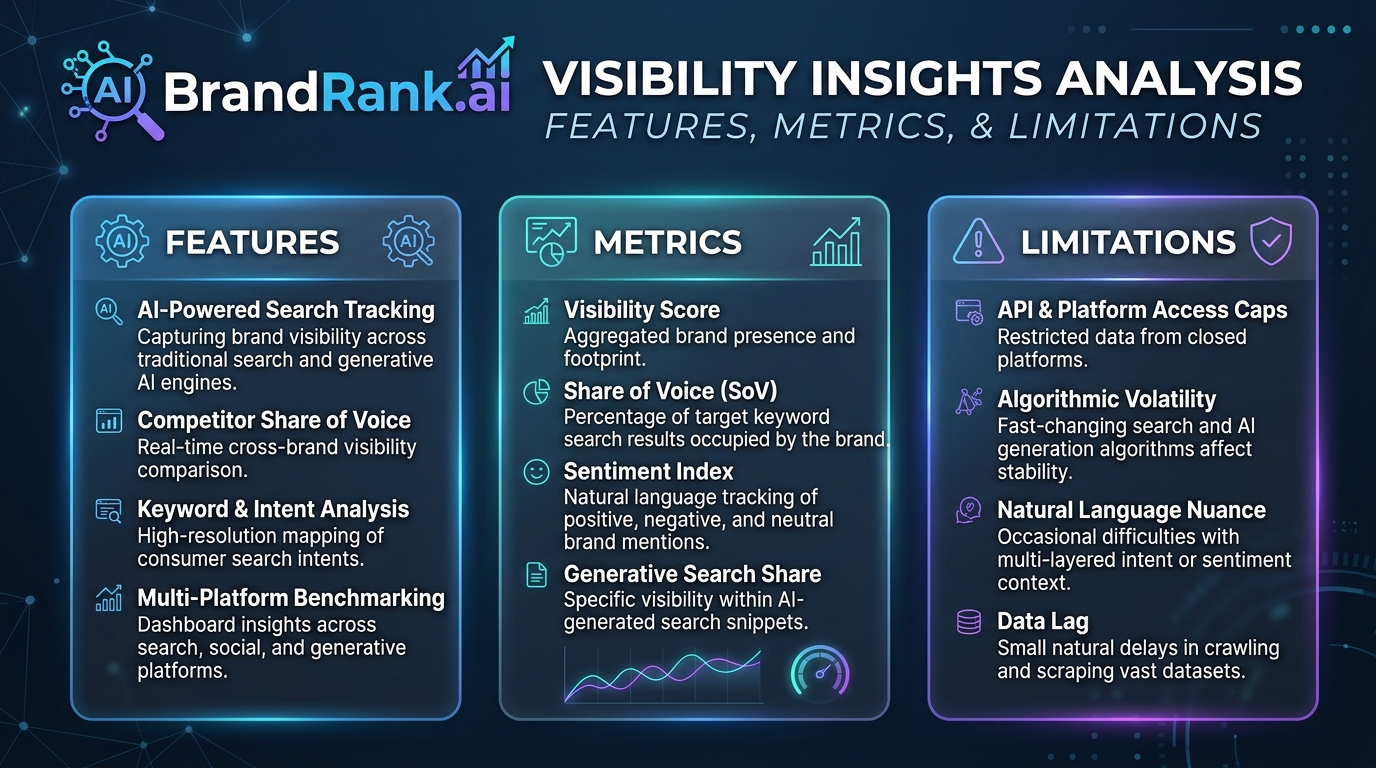
BrandRank.AI provides a useful example of how this problem can be measured. Its published research methodology describes four steps: asking the same customer questions across AI engines, recording their answers, normalizing brand and product names, and checking the results for accuracy. The process helps researchers compare recommendations without treating every variation of a company or product name as a different competitor.
For website owners, SaaS founders, and digital publishers, the practical lesson is clear. Consistent brand information matters, but reliable measurement requires defined rules, source evidence, and careful interpretation of results.
Quick Answer
Brand normalization for AI search is the process of identifying different names that refer to the same brand, product family, or parent company so that AI-generated recommendations can be measured consistently. BrandRank.AI publicly documents a four-step research process: Ask, Answer, Normalize, and Check. During normalization, its research groups names by product family when measuring consensus and by parent company when calculating Recommendation Share. For example, Kindle and Ring can count toward Amazon’s parent-company share while remaining distinct product families. The system also checks whether answers are outdated, inaccurate, or unrelated to the question. These rules help researchers compare AI recommendations, although the results describe what AI engines said during a study, not the real-world quality of the products or services involved.
Key Takeaways
- Brand normalization: Identify equivalent names without erasing meaningful differences between companies and products.
- BrandRank.AI methodology: Its published research follows Ask, Answer, Normalize, and Check.
- Recommendation Share: Measures the proportion of scored answers that name a brand, retailer, or product as the first choice.
- Consensus: BrandRank.AI defines consensus as four or more of six engines naming the same answer in its six-engine research methodology.
- Practical application: Businesses should maintain consistent public brand information and audit AI answers against original evidence.
- Important limitation: AI recommendation measurements are snapshots of model responses, not guarantees of future visibility or product quality.
What Is Brand Normalization for AI Search?
Brand normalization is a data-management process that helps a reporting system recognize equivalent names and associate them with the correct entity.
A company might appear in records under its full legal name, a shortened trading name, or a product name. Without a consistent identification system, reports can split related records across multiple entries or combine unrelated entities incorrectly.
Consider a fictional company called Northstar Technologies. It owns Northstar Cloud, a software product, and Northstar Mobile, a separate application. A report that treats every name as interchangeable could incorrectly attribute product recommendations to the parent company or combine unrelated customer feedback.
A better system records the relationship between the parent company and its products while preserving their individual identities.
This distinction becomes particularly important when measuring AI recommendations. A chatbot might recommend a product, mention its parent company, or name a competitor. Each outcome answers a different question and should be recorded separately.
Why AI search makes normalization useful
Traditional SEO reports often focus on impressions, clicks, rankings, and organic traffic. AI visibility research can also examine which company an answer recommends, which alternatives appear, and whether multiple systems agree.
An AI-generated response may use a product name rather than the parent company’s name. Another response may refer to the retailer or corporate group instead. A consistent mapping system helps analysts determine whether these responses represent related entities.
Normalization does not force AI systems to recognize a brand correctly. It improves the consistency of the reporting process used to analyze their answers.
BrandRank.AI’s Published Four-Step Method
BrandRank.AI explains its research process on its official Research and Indexes page. The method consists of four stages.
1. Ask: Use consistent customer questions
The research begins with questions that real customers might ask when choosing products, retailers, or services.
The same questions are submitted to the selected AI engines under a consistent protocol and within the same research window. This helps researchers compare answers to equivalent requests rather than comparing unrelated prompts.
For example, a study might ask which retailer is best for a particular shopping need. Each participating engine receives the same question, allowing the research team to examine how recommendations differ.
Prompt consistency matters because small wording changes can affect the response. If one engine receives a question about affordability and another receives a question about premium quality, their recommendations may reflect different priorities.
2. Answer: Record the recommendation
For each single-answer question, BrandRank.AI’s published methodology asks each engine to name one retailer, brand, or product, accompanied by a short rationale. Engines may decline to answer.
This creates a defined unit for analysis. Rather than counting every company mentioned in a long response, researchers record the answer selected for the question.
The distinction is important. A brand can appear in an explanation without being the first-choice recommendation. Mention counts alone cannot establish how often an AI engine favors a particular option.
3. Normalize: Group related names correctly
Normalization is the stage that makes the collected responses comparable.
BrandRank.AI says its research groups names by product family when calculating consensus and by parent company when calculating Recommendation Share. Its published example explains that Kindle and Ring can count toward Amazon for the parent-company measure.
The two groupings serve different purposes. Product-family grouping helps researchers assess whether engines agree on a particular product family. Parent-company grouping helps measure the wider share of recommendations associated with a corporate group.
This is a documented part of BrandRank.AI’s research methodology. It should not be confused with a complete public disclosure of every internal data-processing rule the company may use.
4. Check: Review the quality of the answers
After normalization, the research checks for answers that are outdated, inaccurate, or unrelated to the question.
This step matters because a correctly identified brand can still receive an irrelevant or incorrect answer. Normalization fixes identity relationships, but it does not prove that the underlying claim is true.
Researchers also need to account for disagreement between AI engines. One system may name a brand first while another selects a competitor. That difference is a finding, not automatically a data error.
Normalization, Standardization, and Canonicalization
These three terms describe related practices, but they address different problems.
| Method | Main purpose | Example | Common mistake |
|---|---|---|---|
| Normalization | Match equivalent values for analysis | Recognize approved name variants as the same entity | Merging unrelated companies |
| Standardization | Maintain consistent public naming | Use the same approved brand spelling across pages | Leaving old profiles unchanged |
| Canonicalization | Identify an authoritative record or URL where appropriate | Use a preferred URL for a page with duplicate versions | Assuming a canonical URL proves two businesses are identical |
| Validation | Check whether the processed result is correct | Compare a recommendation label with the original answer | Trusting automated classifications without review |
For example, a company may use one name on its website and a historical name in an older directory listing. Normalization can help match the two records if the relationship is verified. Standardization guides future public references, while canonicalization identifies the preferred record or URL for the relevant technical purpose.
These practices work together, but they are not interchangeable. A canonical webpage does not automatically establish the relationship between a parent company and every product it owns.
A Practical Brand Normalization Workflow
Website owners can apply the same general principles to their own brand monitoring, even when they do not use a dedicated AI visibility platform.
Step 1: Create a brand identity record
Start with the official brand name, website, parent company if applicable, product names, and verified aliases.
Record the source for each relationship. A similar spelling is not enough to prove that two names refer to the same organization.
Step 2: Standardize the data used for matching
Decide how your internal reporting will handle capitalization, whitespace, punctuation, and common legal suffixes.
For example, a matching process might compare names without regard to capitalization while preserving the original spelling for display. It should not remove meaningful product distinctions simply to make matching easier.
Keep both the original value and the normalized value. This allows reviewers to understand what changed and reverse a mistaken match.
Step 3: Maintain parent and product relationships
Represent the company and its products as separate records connected through explicit relationships.
For instance, a parent company may own several software products. A product-level recommendation should remain associated with the correct product even when a parent-company report aggregates it.
This structure is especially useful for SaaS businesses with multiple applications, brands, and pricing tiers.
Step 4: Run consistent AI prompts
Choose questions that reflect actual customer decisions. These might cover the best product for a specific task, the strongest alternative to a named competitor, or the best service for a defined budget.
Record the exact prompt, AI engine, date, answer, and available citations. If the prompts change between reporting periods, document the change rather than treating the results as directly comparable.
Step 5: Classify recommendations separately from mentions
A useful reporting schema should distinguish a first-choice recommendation from a passing mention, a negative comparison, or an answer that does not address the question.
When a classification is uncertain, retain the original answer for human review. Do not automatically interpret every brand mention as a positive recommendation.
Step 6: Validate and document the rules
Review a sample of processed answers against the original responses. Check entity relationships, recommendation labels, citations, and outdated information.
Keep a record of changes to your rules. If a result changes after an update, the team should be able to determine whether the AI answer changed or the classification process changed.
Understanding Recommendation Share and Consensus
BrandRank.AI uses two distinct concepts in its published research.
Recommendation Share measures the share of scored answers that name a given retailer, brand, or product. Its methodology counts first-choice recommendations rather than all mentions.
Consensus describes agreement between engines. In BrandRank.AI’s documented six-engine methodology, a question has consensus when at least four of the six engines name the same answer. Unanimous agreement means all six select the same answer.
These measurements answer different questions. Recommendation Share measures how often a brand receives first-choice status within the scored responses. Consensus measures how closely the engines agree on an individual question.
A company could receive recommendations from several engines while still facing substantial disagreement about the best option in its category. Both measurements can be useful, provided the analyst understands the study’s sample, questions, engines, and dates.
BrandRank.AI’s research page also makes an important qualification: its indexes measure what AI engines say at the time of a study. They are not product tests and do not establish how well the companies or products perform in the real world.
Tools and Standards That Support Better Brand Data
A dedicated platform is only one part of a sound workflow. The appropriate setup depends on how many brands, products, and answers need to be monitored.
| Tool or resource | Best use | Main limitation |
|---|---|---|
| Spreadsheet | Maintain brand aliases and manually audit records | Manual checks become harder as data grows |
| Database | Store entities, parent relationships, and answer history | Requires a well-designed data model |
| Python data-processing tools | Apply repeatable matching and classification rules | Poor rules can introduce systematic errors |
| BrandRank.AI research | Study AI recommendations using its published methodology | Results represent the tested questions and period |
| Schema.org structured data | Describe entities and page information in a standardized format | Does not guarantee AI recommendations or search visibility |
Google’s structured data documentation explains how structured data can provide explicit information about a page and the entities it describes. Website owners should ensure that markup accurately reflects visible content and follows the relevant technical guidelines.
Google also explains its approach to AI search features in its official AI features guidance. Existing SEO fundamentals remain relevant, but no special markup guarantees inclusion in AI Overviews or AI Mode.
These resources help separate verifiable technical practices from unsupported claims about ranking formulas.
Common Mistakes in Brand Normalization
Combining different products under one name
Parent-company aggregation can be appropriate for one report and misleading for another. Keep product-level identity intact when the question concerns a specific product.
Treating every mention as a recommendation
A company may appear in a response because the AI engine is explaining why it is unsuitable. Record the recommendation outcome, not just the presence of the name.
Assuming normalization guarantees AI visibility
Consistent naming can improve the quality of reporting and reduce avoidable identity errors. It does not force an AI system to recommend a brand or cite a particular webpage.
Ignoring outdated information
Old product names, retired services, and incorrect company details can affect the interpretation of AI answers. Maintain a review process for important facts and record the evidence supporting corrections.
Comparing incompatible research samples
Results from different question sets, engines, or dates may not be directly comparable. Record the research protocol and disclose any meaningful changes between measurement periods.
Practitioner Tip:
Keep the raw AI response beside every normalized record. When a report identifies a first-choice recommendation, preserve the exact answer, prompt, engine, and date. This audit trail helps you investigate errors without having to reconstruct an earlier research run.
How to Audit Your Brand’s AI Visibility
A small business can start with a simple, repeatable process.
- Write down the official company and product names.
- Verify parent-company relationships and approved aliases.
- Select a consistent set of questions based on real customer needs.
- Test those questions across the AI engines included in your research.
- Record answers, dates, recommendations, and citations.
- Normalize verified entity relationships without merging unrelated products.
- Review outdated, inaccurate, or irrelevant answers.
- Repeat the study using the same protocol and compare the results.
This approach can reveal whether AI systems consistently recommend a brand, whether competitors receive more first-choice recommendations, and whether certain questions produce conflicting answers.
It cannot establish that a specific SEO change caused a change in AI recommendations without additional evidence. Other factors, including model updates and changes to the questions or sources, may influence the results.
Final Verdict
Brand normalization is an important part of measuring how AI engines represent companies and products. BrandRank.AI’s published Ask, Answer, Normalize, and Check process offers a concrete example of how consistent questions and carefully grouped names can support comparative research.
The key is to preserve the distinction between a product and its parent company, measure first-choice recommendations separately from mentions, and verify answers against their original evidence.
For independent publishers and SaaS founders, a reliable record of brand identity and AI recommendations is a practical starting point. It makes reports easier to interpret and helps teams identify where the evidence supports a conclusion, where engines disagree, and where further investigation is needed.
Frequently Asked Questions
What are BrandRank.AI normalization rules?
BrandRank.AI publicly describes a research process that groups names by product family for consensus and by parent company for Recommendation Share. Its broader methodology also includes asking consistent questions, recording answers, and checking their quality.
What are the four steps in BrandRank.AI’s research methodology?
The four published steps are Ask, Answer, Normalize, and Check. Together, they define how the research collects AI responses, groups related names, and reviews the results.
What is Recommendation Share?
Recommendation Share is the share of scored answers that name a given retailer, brand, or product as the first choice. It is different from a simple count of all brand mentions.
What does consensus mean in BrandRank.AI research?
In the company’s documented six-engine methodology, consensus occurs when four or more engines name the same answer to a question. Unanimous agreement means all six name the same answer.
Does brand normalization improve Google rankings automatically?
No. Accurate brand information and appropriate structured data can help search engines interpret website content, but normalization does not guarantee higher rankings, AI citations, or recommendations.
Can small publishers use these methods without a paid platform?
Yes. A spreadsheet, verified brand records, consistent prompts, and manual answer reviews can support a basic audit. More advanced tools may become useful when the number of products and records grows.