Quick Answer:
Droven.io is not a business automation platform. It’s an editorial site publishing explanatory content on AI, automation, and digital transformation topics. No sign-up page, no dashboard, no pricing tier, and no public API exist for it. Businesses searching for an actual AI automation tool should look at established platforms such as Zapier, Make, n8n, or UiPath, each of which has a live product, transparent pricing, and documentation available today. The “droven.io ai for business” phrase spread mainly through a cluster of similar-sounding articles rather than through any product launch.
Type “droven.io ai for business” into a search bar and you’ll land on a pile of guides describing features, use cases, even pricing tiers for something that, on closer inspection, doesn’t exist as a purchasable product. That gap between what’s written and what’s verifiable is the entire point of this piece.
Separating the Name From the Claims

Start with what’s confirmed. Droven.io publishes written content aimed at business readers curious about artificial intelligence: explainer posts on machine learning basics, robotic process automation, cloud computing, and how companies are folding these into daily operations. That’s a normal, useful function for a content site to serve.
What isn’t confirmed anywhere is a software product attached to the name. No dashboard screenshots exist outside of illustration graphics. No account creation flow has been documented. No changelog, release notes, or technical documentation site has surfaced. Search for a pricing page and you find none, because there’s nothing to price.
Yet a specific batch of articles, most published within a short window during 2026, describe Droven.io using language typically reserved for actual SaaS products: “scalable and beginner-friendly,” “machine learning as a service,” “smart data processing engine.” None of these descriptions link back to a working feature, screenshot, or demo. They read like product marketing copy attached to something with no product behind it.
Key Takeaways
- Droven.io functions as a content and education resource, not a deployable software tool.
- A wave of nearly identical articles created the impression of a product where none has been verified to exist.
- Businesses looking for genuine AI automation capability should evaluate established platforms with public pricing and documentation instead.
How a Content Site Got Mistaken for a Product
This kind of mix-up isn’t new, but it has a specific shape worth understanding. A phrase starts gaining search volume, in this case “AI for business” paired with a site name that already publishes related content. Writers chasing that traffic produce articles fast, often without checking whether the underlying claim holds up, and each new article borrows structure and wording from the last one. Within a few months, dozens of pages exist repeating the same unverified description, and search engines start treating repetition as a signal of consensus.
Google’s guidance on producing helpful, reliable content specifically warns against material written primarily to capture search traffic rather than to inform readers accurately, and the pattern around this keyword fits that warning closely: nearly identical structure, nearly identical claims, spread across sites with little independent authority.
The practical lesson for anyone researching a tool online: repetition across search results is not the same as verification. A claim repeated fifty times with zero supporting screenshots or demos is still an unverified claim.
Practitioner Tip:
Before trusting any write-up about a supposed AI tool, look for three concrete signs of a real product: a working sign-up or trial link, a documented API or integrations page, and a support channel where you can reach an actual team. Absence of all three is a strong signal you’re reading about a concept, not a product.
What Businesses Actually Need When They Search This Phrase
Set the naming confusion aside for a moment, because the underlying question behind “AI for business” searches is legitimate. Companies genuinely want to know how artificial intelligence fits into daily operations, and that answer doesn’t hinge on any single website’s identity. It breaks down into a few well-established categories.
Workflow automation handles the connective tissue between apps: a form submission updates a spreadsheet, a new customer triggers a welcome sequence, a support ticket routes to the right person automatically. This is usually the fastest win for a small team.
Document and data processing uses AI to read unstructured material such as invoices, contracts, or scanned forms, extracting the relevant fields without a human retyping everything by hand. This category has improved sharply over the past few years as language models got better at parsing messy formats.
Customer support automation covers AI-driven chat and ticket triage, resolving routine questions instantly and escalating anything complex to a human agent.
Sales and revenue intelligence tools score leads, summarize sales calls, and draft outreach based on account activity, saving reps hours of manual note-taking and research.
For most independent creators, small SaaS teams, and solo founders, starting with general workflow automation delivers the quickest return, since it requires the least setup and produces visible time savings almost immediately.
Actual Platforms Worth Considering
Here’s an honest rundown of the tools businesses turn to when they want real AI-assisted automation, along with what makes each one distinct.
Zapier remains the easiest entry point for most people, largely because of its enormous library of app integrations, well past seven thousand at last count. Setup takes minutes, and its AI features now handle more complex multi-step logic than the platform’s original simple trigger-action model. Pricing starts around twenty dollars a month for paid tiers, with a limited free plan available.
Make, previously known as Integromat, trades some of that beginner simplicity for a visual workflow canvas that gives far more control over branching logic and data transformation. Teams that outgrow simple automations tend to migrate here. Entry pricing sits lower than Zapier’s, closer to nine dollars monthly, though complexity climbs with usage.
n8n stands apart by being open source and self-hostable, appealing to technically capable teams that want to avoid per-task billing or keep sensitive data entirely within their own infrastructure. Hosted plans exist too for those who don’t want to manage servers themselves.
UiPath operates at a different scale entirely, aimed at enterprise operations teams running attended and unattended bots alongside AI agents for document processing and governance-heavy workflows. It carries a steeper learning curve and custom enterprise pricing, making it a poor fit for a solo creator but a strong option for larger operational teams juggling compliance requirements.
None of these require a third party to explain their existence. Each one offers a free trial or limited free tier you can test within minutes, which is precisely the kind of verification that’s missing from the Droven.io product claims.
Practitioner Tip:
Resist the urge to automate everything on day one. Pick your single most repetitive task, the one eating the most hours weekly, build that one workflow, confirm it actually saves time in practice, then expand from there. Teams that try to automate ten processes simultaneously tend to abandon half of them within a month.
A Short Checklist for Evaluating Any AI Vendor
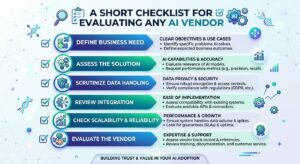
Whether you’re comparing Zapier against Make or investigating a name you’ve never heard before, the same due diligence applies.
First, check whether you can see the actual product without booking a sales call. A genuine free trial or public demo is a healthy sign; a wall requiring a sales conversation just to learn basic pricing is a caution flag for smaller buyers.
Second, look for a documented API and an active changelog. Products that are actually being developed publish updates regularly. Silence for months at a time usually signals stalled development or, worse, no development at all.
Third, weigh independent adoption research against marketing claims. Broad industry surveys, including work published by major research firms tracking enterprise AI adoption, consistently find that a majority of organizations now use AI in at least one business function, but a meaningful share began without properly mapping their processes first and ended up choosing the wrong tool for their actual maturity level. Understand your own workflow before shopping for a solution to it.
Fourth, confirm the vendor’s governance model matches your risk tolerance, particularly if the tool will touch customer records or financial data. Ask directly about audit trails, human review checkpoints, and data handling policies before signing anything.
Final Verdict
Droven.io is, by every verifiable account, a content publisher covering AI and automation topics for a business readership, not a software tool. There’s no product to sign up for, no dashboard to log into, and no benchmark worth running, because nothing exists to benchmark. Articles suggesting otherwise are working from assumption rather than evidence, and that gap is worth knowing before you spend time researching features that were never real.
If the actual goal is automating work inside your business, skip the naming confusion and go straight to a platform with a working product behind it. Zapier gets you moving fastest. Make offers more control once you outgrow simple automations. n8n suits teams that want to self-host. Test the free tier before committing budget anywhere, and automate one genuinely repetitive task first rather than attempting a full operational overhaul in week one. That path will get real results faster than any article promising a shortcut, this one included.
FAQs
Is Droven.io an actual AI automation tool?
No. It functions as an editorial site publishing content about AI and automation topics. There is no software product, account system, or dashboard tied to the name.
Can businesses use Droven.io to automate their operations directly?
Not directly. At most, it serves as reading material on automation concepts. Actual task automation requires signing up for a working platform such as Zapier, Make, n8n, or UiPath.
Why does so much content online describe Droven.io as a software platform?
A cluster of closely related articles, published across a number of lower-authority sites within a short span in 2026, described it using product-style language despite no public product ever surfacing. This pattern is typical of content written to capture search traffic around a trending phrase rather than to report verified facts.
Which AI automation tool suits a small business or solo founder best?
Zapier is generally the simplest starting point thanks to its wide integration library and quick setup. Make offers more control at a comparable price for those willing to learn a steeper interface. n8n fits technically minded teams wanting to self-host and avoid usage-based billing.
Should readers avoid Droven.io’s content entirely?
Not necessarily. As an educational resource it may still explain useful concepts clearly. The concern isn’t the site’s own content, but the surrounding wave of third-party articles misrepresenting it as a product it has never claimed to be.