When an unfamiliar website appears in search results, its name alone rarely tells you what it offers. Readers searching for domikyo com may want to understand the website’s purpose, the subjects it covers, whether its information is reliable, and what they should check before using its content.
Domikyo.com has been described in publicly available online articles as a general information and digital publishing website. Some external descriptions connect it with technology, smart homes, networking, and connected devices, while others associate the name with broader subjects such as business, finance, health, and lifestyle. These descriptions do not establish that every category is currently active or that all claims about the site are accurate.
Understanding the difference between verified details and third-party descriptions is essential. This guide examines what can reasonably be established, how readers can assess the website, and which checks matter before relying on information found online.
Quick Answer: What Is Domikyo.com?
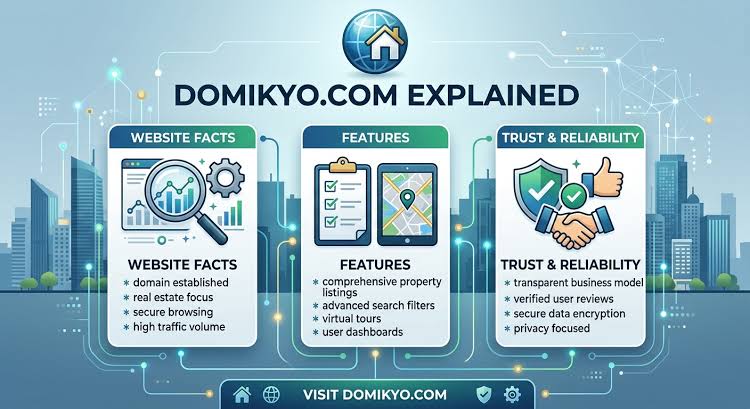
Domikyo.com is associated with online informational content, although publicly available descriptions differ about its primary subject areas. External articles discuss technology, digital connectivity, smart-home topics, business, finance, lifestyle, and other general-interest subjects. However, these reports do not independently confirm the website’s complete current content, ownership, editorial team, or every service it may offer. Readers should visit the exact domain, inspect its current pages, and review the publication dates, author details, references, privacy information, and contact options before making a judgment. Domikyo.com is best approached as a website whose individual pages should be assessed on their own evidence. Search visibility, HTTPS, or a professional appearance alone cannot establish that every published claim is accurate or that every link is safe.
Key Takeaways
- Website purpose: External descriptions associate Domikyo.com with informational publishing, but its complete current scope needs direct verification.
- Topic coverage: Technology, smart homes, business, finance, and lifestyle appear in third-party descriptions. Their current availability has not been fully confirmed.
- Trust assessment: Review authors, dates, references, ownership details, and privacy policies rather than relying on appearance alone.
- Online safety: HTTPS protects information in transit, but it does not prove that a website or its content is trustworthy.
- Research quality: Use official documentation and qualified sources to verify important technical, financial, health, or security claims.
What Is Domikyo.com?
Domikyo.com is a domain name associated with an online information website in several third-party publications. These publications describe it as a place where readers may find articles and explanations about technology and other everyday subjects.
Some coverage places particular emphasis on smart-home systems, connected devices, internet networking, and digital technology. Other descriptions present a wider publishing model that includes business, finance, health, education, travel, and lifestyle.
This variation deserves attention. A third-party article may describe a site’s intended purpose, rely on earlier information, or make assumptions based on a limited number of pages. It should not automatically be treated as confirmation of the website’s current editorial strategy.
For an accurate assessment, start with the domain itself. Check its homepage, category pages, About page, and recent articles. These pages provide stronger evidence of its current public presentation than an unrelated website’s description.
It is also important to distinguish an informational website from a software product. A site that publishes articles about connected devices does not necessarily manufacture those devices or provide a home-automation application.
What Topics Does Domikyo.com Cover?
Public descriptions associate Domikyo.com with several subject areas. The following overview separates reported topics from what readers should verify.
Technology and Digital Connectivity
Technology is one of the recurring subjects in third-party descriptions of Domikyo.com. Related discussions mention software, internet connectivity, smart devices, networking, and digital tools.
Articles in these areas can help readers understand technical terms, compare approaches, or identify questions to ask before buying a product. Their usefulness depends on the quality of the research and whether the instructions match current software and hardware.
For example, a networking guide should explain the conditions under which its recommendations apply. If a router manufacturer changes its settings, older instructions may no longer match the device.
Readers should check technical advice against official product documentation, particularly when an error could affect network security or device performance.
Smart Homes and Connected Devices
Some external publications describe Domikyo.com in connection with smart homes and the Internet of Things, commonly shortened to IoT. This field includes devices that communicate through a network, such as connected lights, sensors, thermostats, and certain household appliances.
A useful smart-home article explains compatibility, network requirements, privacy considerations, and the limitations of the products it discusses. These details matter because devices from different manufacturers do not always work together in the same way.
However, the available descriptions do not establish that Domikyo.com sells its own hardware or operates a dedicated smart-home control service. Readers should treat it as an information source unless the site’s own verified pages demonstrate otherwise.
Business and Finance
Other descriptions associate the Domikyo name with business and finance topics. General-interest publishing websites often cover subjects such as entrepreneurship, online business, budgeting, and digital services.
The quality of this material depends on the evidence behind each claim. A business overview may offer useful background, but financial recommendations require more care because circumstances, rules, fees, and market conditions differ.
Readers should verify important financial information through appropriate official sources. An article should make its purpose clear and distinguish general education from personalized professional advice.
Lifestyle and General Information
Lifestyle, education, travel, health, and other general-interest subjects also appear in external descriptions of Domikyo.com.
Broad coverage can help readers discover unfamiliar subjects in one place. It can also make it harder to determine whether a particular article has enough subject-specific research behind it.
A useful article should answer a clear question, provide relevant evidence, and explain the limits of its advice. Readers should not assume that every article on a multi-topic website has the same level of editorial review.
How to Evaluate Domikyo.com’s Credibility
A website’s credibility depends on evidence, transparency, and the quality of its published material. No single visual or technical signal can settle the question.
1. Check the Author and Publisher
Look for a named author, a meaningful biography, and details about the publication responsible for the article. Where expertise matters, the author should have relevant qualifications or demonstrate appropriate subject knowledge.
An author name by itself is not proof of expertise. Check whether the biography contains verifiable details and whether the article accurately represents its sources.
Also look for an About page and contact information. These details help readers understand who publishes the material and how to raise a question about it.
If ownership information is unavailable, record that as an unresolved question rather than guessing who runs the domain.
2. Review Publication and Update Dates
Publication dates help readers understand when an article first appeared. Update dates can indicate whether the information has been reviewed since publication.
Dates are particularly important for technology instructions, financial rules, privacy policies, and product comparisons. Software interfaces and service terms can change after an article goes live.
An updated date is useful only when it corresponds to a meaningful review. Changing a date without checking the underlying information does not make an article current.
3. Follow the References
Good informational content makes important claims easy to check. It may cite official documentation, original research, public records, or recognized subject experts.
For technology questions, the Google Search Central documentation explains Google’s guidance on creating helpful, reliable, people-first content. It is a useful reference for understanding why original value, accuracy, and a clear purpose matter in online publishing.
For a specific claim, follow the reference and confirm that it actually supports the statement. A list of outbound links is not enough if those links lead to unrelated or weak material.
4. Read the Privacy and Terms Pages
A privacy policy should explain what personal information a website collects, why it collects that information, and how that information is handled. Terms of use may explain the rules that apply to visitors.
Read these pages before creating an account, submitting personal details, or using a feature that requests information. If the site asks for data that appears unrelated to its stated purpose, pause and assess whether sharing it is necessary.
The existence of a privacy policy does not automatically prove that a website follows every statement in it. The policy should be clear, relevant, and consistent with the site’s actual practices.
5. Distinguish Security Signals From Trust
HTTPS encrypts information exchanged between a browser and a website. This helps protect data while it travels across the connection.
However, HTTPS does not verify every claim made by a publisher, confirm its ownership, or guarantee that its downloads and external links are safe.
For a more complete security check, review browser warnings, avoid unexpected downloads, and be cautious when a page requests passwords or payment information. Do not rely on a single technical signal to make a final decision.
Domikyo.com at a Glance
| Assessment Area | What Available Information Suggests | What Still Needs Verification |
|---|---|---|
| Website purpose | Associated with informational publishing | Current scope and primary editorial focus |
| Technology content | Mentioned in external descriptions | Current article selection and technical accuracy |
| Smart-home topics | Reported by some publications | Active coverage and depth of guidance |
| Business and finance | Included in broader descriptions | Current categories and quality of advice |
| Ownership | No owner established by the sources reviewed for this article | Legal publisher, operating company, or responsible individual |
| Editorial standards | Cannot be established from the domain name alone | Author credentials, corrections policy, and sourcing practices |
| Online safety | Must be assessed through technical and content checks | Page-specific security, privacy, and external-link risks |
This table reflects the limits of the available evidence, not a definitive security audit or a full inspection of every page on Domikyo.com.
How Readers Can Use Domikyo.com More Effectively
If you visit Domikyo.com for information, begin with the question you want to answer. A focused approach makes it easier to judge whether an article is useful.
For technology research: Compare instructions with official manufacturer documentation. Check the product model, software version, and date before following a procedure.
For smart-home research: Review device compatibility, network requirements, privacy settings, and support information before purchasing equipment or changing a connected system.
For business information: Look for clear examples and references. Verify important claims about costs, regulations, contracts, and commercial services with appropriate primary sources.
For health or financial topics: Treat general articles as background information, not as a replacement for qualified advice tailored to your circumstances.
For general learning: Check the author’s identity, the article’s purpose, and the evidence behind its main conclusions. A clear explanation is more useful when readers can independently verify its important claims.
These practices apply to any online publication, whether it is well known or unfamiliar.
Why Clear Website Information Matters
Readers should be able to determine what a website publishes, who is responsible for its content, and how its claims can be checked.
Clear category labels help visitors find relevant material. Author biographies give context to specialist advice. Publication dates show when information appeared, while meaningful updates help readers judge whether it remains current.
These details also help publishers build credibility over time. A site gains more from accurate, useful articles than from unsupported claims about authority or trust.
For publishers, Google’s guidance on creating helpful, reliable content provides a practical starting point. Content should meet a real reader need, offer original value, and make its limitations clear when evidence is incomplete.
A site should also correct factual errors when they come to light. This practice helps readers understand which information has been checked and gives them a reason to return.
Final Verdict
Domikyo.com has an online publishing footprint in third-party descriptions, but its exact current focus, ownership, and editorial practices cannot all be confirmed from the information reviewed here.
That distinction matters. A website can be useful for general research while still requiring readers to verify important claims. The right approach is to assess the individual article, check its references, and consider the potential consequences before acting on its advice.
Readers interested in technology, connected devices, business, or general information should begin with the site’s current pages and look for clear evidence of accuracy and accountability. For sensitive decisions, use appropriate official sources and qualified professionals.
A careful assessment produces a more useful answer than an unsupported claim that a website is either fully trustworthy or inherently unsafe. Until more details are verified, Domikyo.com should be evaluated on the quality and transparency of the information it actually provides.
Frequently Asked Questions
What is Domikyo.com?
Domikyo.com is associated with an online information and publishing website. Third-party descriptions connect it with technology and other general-interest subjects, but its complete current scope requires direct verification.
What topics does Domikyo.com cover?
External descriptions mention technology, smart homes, networking, business, finance, lifestyle, and other subjects. Readers should inspect the live website to confirm which categories and articles are currently available.
Is Domikyo.com a smart-home product?
The available descriptions associate the domain with smart-home information, but they do not establish that it manufactures devices or provides its own home-automation system.
Who owns Domikyo.com?
The sources reviewed for this article do not establish a verified owner or operating company. Readers should consult reliable domain records and the website’s own publisher information rather than relying on unverified claims.
Is Domikyo.com safe to visit?
This article does not establish a definitive security verdict. Use an up-to-date browser, pay attention to security warnings, avoid unexpected downloads, and assess individual pages before sharing personal information.
Can readers trust information published on Domikyo.com?
Trust should be assessed article by article. Check author credentials, publication dates, references, and whether important claims agree with reliable primary sources.
Is Domikyo.com free to use?
The current pricing and access terms have not been independently confirmed for this article. Check the live website for any registration requirements, subscriptions, or paid services before proceeding.
Does Domikyo.com provide professional advice?
The available evidence does not establish the scope of any professional services. Treat general articles as informational unless the publisher clearly identifies a qualified service and its terms.
How can I verify information from Domikyo.com?
Compare important claims with official documentation, government resources, original research, or qualified experts. For technical instructions, confirm that they apply to your specific product or software version.