Quick Answer
A WordPress SEO agency combines technical site work (Core Web Vitals, schema, crawl structure, plugin conflicts) with content strategy and link building, specifically inside the WordPress environment. Pricing typically runs $800 to $5,000 a month for small and mid-size sites, depending on scope. The strongest agencies show you a technical audit before pitching a retainer, name the plugins they will touch, and give a realistic 4 to 9 month timeline for ranking movement rather than promising fast results.
A client once handed me a WordPress site running four SEO plugins at the same time. Two were fighting over the sitemap. One was injecting duplicate meta tags. Nobody on the previous “SEO team” had noticed for eight months, because nobody on that team had actually opened the plugin settings screen.
That is the gap most articles about hiring an SEO agency skip. WordPress is not a neutral platform. It has its own failure points: plugin bloat, theme-generated markup, caching layers that break dynamic content, and a plugin ecosystem where three tools can quietly overwrite each other’s work. Hiring a WordPress SEO agency without a WordPress-specific evaluation is close to hiring a mechanic who has only worked on trucks to fix your motorcycle. The general principles carry over. The specifics do not.
Key Takeaways
- Technical audits come first: a serious agency inspects your plugin stack, theme markup, and Core Web Vitals before quoting a retainer.
- Pricing scales with scope, not promises: small business retainers usually land between $800 and $2,500 monthly; competitive niches run $3,000 to $5,000 or more.
- Timelines under 90 days are a warning sign: real ranking movement on WordPress sites typically takes 4 to 9 months, depending on domain age and competition.
What a WordPress SEO Agency Actually Does
Strip away the sales language and the work splits into three buckets: technical, content, and authority.
Technical work means auditing theme-generated HTML for bloat, checking whether Core Web Vitals scores hold up under real traffic (not just a single Lighthouse run), fixing crawl issues from faceted navigation or tag pages, and making sure the SEO plugin is not creating orphaned sitemap entries. Google’s own Web Vitals documentation measures loading, interactivity, and visual stability as real-world user experience signals, not synthetic lab scores, which is exactly why a one-time PageSpeed screenshot in a sales deck means very little.
Content work covers keyword mapping against existing pages, identifying cannibalization (a common WordPress problem when blog categories and tags both generate indexable archive pages), and writing or editing content that matches search intent rather than hitting a keyword density target.
Authority work is link building and structured data. A competent agency implements schema markup correctly, using the shared vocabulary at Schema.org, rather than stuffing a generic schema plugin with default values nobody reviewed.
Why WordPress Specifically Changes the Job
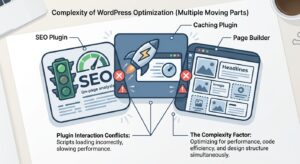
A generic SEO consultant can write good content and build links on any platform. What they often miss on WordPress is plugin interaction. I have seen Yoast and RankMath both active on the same install, each writing its own canonical tag, with the theme’s own header file adding a third. The browser renders one of them. Search engines may read all three signals and pick unpredictably.
Caching plugins cause a second problem. A site with aggressive full-page caching can serve stale versions of pages to Googlebot after a content update, delaying the impact of even good SEO work by weeks. An agency that does not ask about your caching setup in the first call has not done this before on a production site.
Page builders add a third layer. Sites built with heavy visual builders (Elementor, Divi, WPBakery) generate significantly more markup per page than hand-coded HTML. That extra weight affects Largest Contentful Paint directly, and it is one of the most common reasons a WordPress site scores poorly on Core Web Vitals despite looking fine to a human visitor.
Practitioner Tip:
Before signing any retainer, ask the agency to run a search for site:yourdomain.com in Google and compare the result count to your actual published page count. A gap of more than 20 percent usually points to duplicate content from tag archives, print-friendly URLs, or paginated comments, all common on WordPress and all fixable in a single technical sprint.
Pricing: What You Should Expect to Pay
Pricing varies more by agency structure than by client size. A boutique operator with three people charges differently than a 40-person agency with account managers and a separate content team, even for similar deliverables.
Retainers below $500 a month almost always mean templated reports and outsourced link building of variable quality. Retainers above $6,000 usually mean either an enterprise site with real technical complexity, or an agency padding scope with meetings and reporting overhead rather than execution hours.
| Provider Type | Primary Strength | Typical Turnaround | Monthly Pricing |
|---|---|---|---|
| Boutique WordPress Specialist | Deep plugin and theme troubleshooting | 4 to 6 months for first gains | $1,200 to $3,000 |
| Full-Service Digital Marketing Agency | Combined SEO, paid ads, and design | 5 to 9 months | $2,500 to $6,000 |
| Freelance SEO Consultant | Direct access, lower overhead | 4 to 8 months, pace varies | $600 to $2,000 |
| In-House Hire | Full context on business goals | 6 to 12 months to full productivity | $4,000 to $8,000 salary equivalent |
These ranges assume a small to mid-size business site, not an enterprise property with tens of thousands of pages. Enterprise WordPress SEO work, especially on multisite installs, runs well past these numbers and usually gets quoted per project rather than as a flat retainer.
Red Flags That Show Up in the First Call

Guaranteed rankings within 30 days is the most common one. No agency controls the algorithm closely enough to promise a position, and Google’s own SEO Starter Guide is explicit that no one can guarantee a first-page ranking, since results depend on factors outside any single site owner’s control.
Vague reporting is the second flag. If the monthly report is a screenshot of rising traffic with no breakdown of which pages moved, which keywords improved, and what work drove it, you are looking at a retention document, not a performance report.
A third flag is reluctance to explain plugin choices. Ask directly which SEO plugin they use and why, and whether they plan to disable any existing ones. An agency that cannot answer this in a sentence or two has not actually looked at your site yet.
How to Structure the First 90 Days
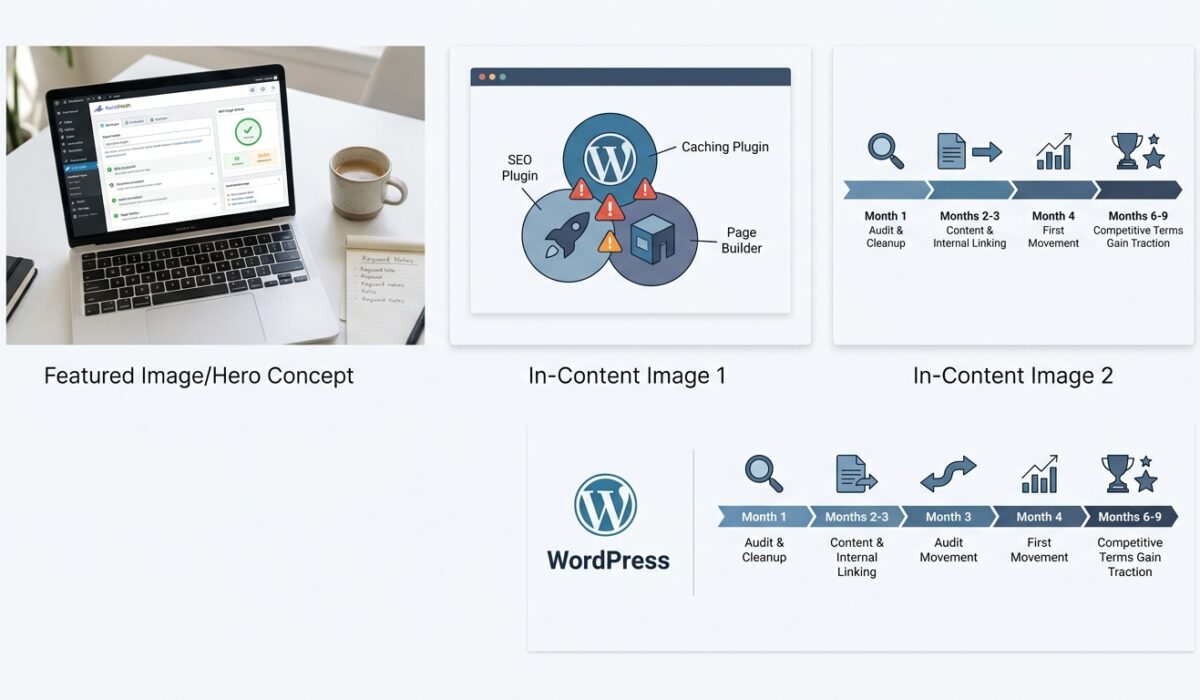
The first month should be almost entirely audit and cleanup: technical crawl fixes, plugin conflict resolution, a Core Web Vitals baseline, and a keyword map tied to actual business priorities rather than generic volume.
Months two and three shift toward content production and the first wave of internal linking fixes. This is also when the agency should be watching Search Console for indexing changes triggered by the month-one technical work. If nothing shifts by week six, that is worth a direct question, not a quiet wait.
By month four, you should see movement on a subset of target keywords, usually the lower-competition ones first. Competitive head terms take longer, often 6 to 9 months, and any agency promising otherwise for a genuinely competitive niche is setting an expectation it cannot control.
Making the Final Call
The agencies worth hiring ask more questions in the first call than they answer. They want to see your Search Console access before quoting a price. They talk about your specific plugin stack, not generic SEO theory. And they are comfortable saying a competitive keyword will take nine months, because that is closer to the truth than a thirty-day promise.
The ones to avoid sound confident about everything and specific about nothing. If a proposal reads the same as one you’d get for a Shopify store or a static HTML site, the agency has not actually engaged with what makes WordPress different, and that gap will show up in your results six months later.