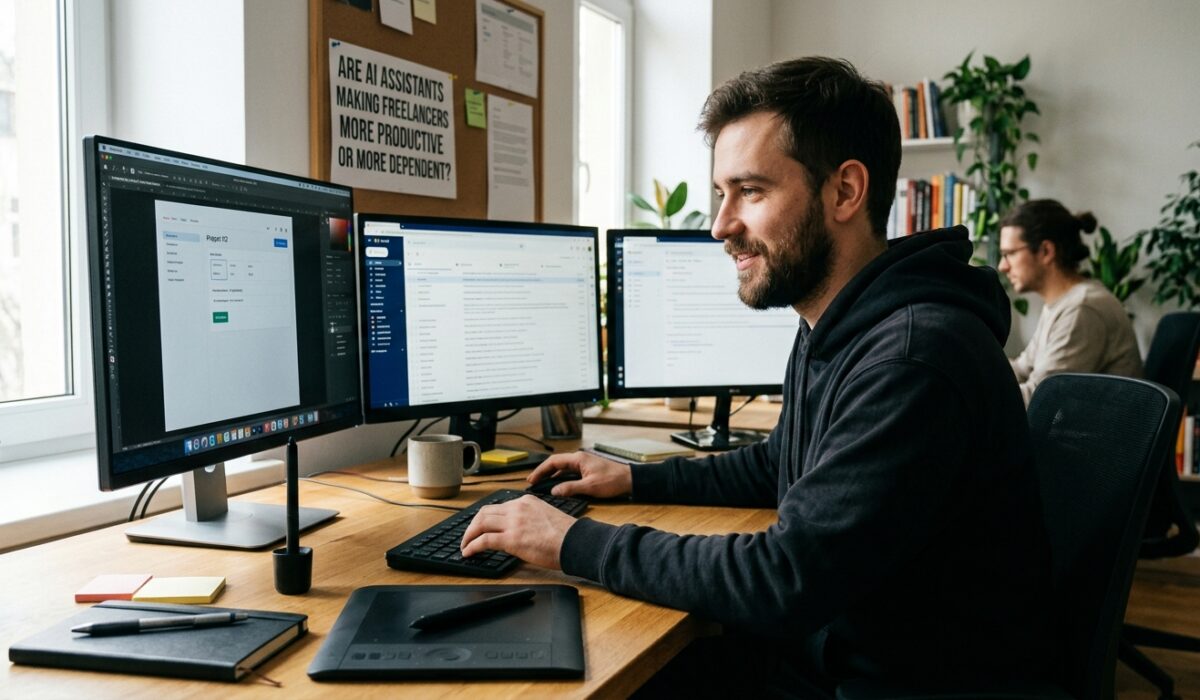
Artificial intelligence is changing how freelancers work, and the shift is happening fast. Tasks that once took hours, from writing proposals to researching clients, can now take minutes with tools like ChatGPT, Claude, and Microsoft Copilot.
For independent workers, the appeal is clear. More work gets done in less time, leaving room for additional projects and higher earnings. But the growing use of AI assistants has also raised an uncomfortable question. Are freelancers becoming better at their jobs, or are they slowly losing the skills that made them independent?
New research suggests the answer isn’t straightforward. While AI improves efficiency, concerns about critical thinking, work pressure, and dependence on automated tools are becoming harder to ignore.
AI Is Changing What Freelancers Can Accomplish
The productivity gains are becoming harder to ignore
Freelancers have always relied on technology to manage their workloads. Project management apps, cloud storage, and automated invoicing are nothing new. AI, however, is changing more than how people organize their work.
Writers use AI to create outlines. Designers generate early concepts. Developers ask coding assistants to identify errors. Virtual assistants automate research and administrative tasks.
The financial impact is also becoming clearer.
According to Upwork’s July 2026 Future Workforce Index, freelancers performing AI-related work on its marketplace earned 34% more per hour than those who weren’t. The study also found that skilled freelancing among US knowledge workers increased from 28% to 38% within a year.
Still, higher productivity doesn’t always mean a healthier working life.
Many freelancers face unstable income, demanding clients, and constant pressure to remain available. For those already dealing with mental health concerns or substance use problems, these pressures can complicate existing challenges.
Such situations sometimes require professional support, including co-occurring disorders treatment, which addresses mental health and substance use conditions together.
AI can reduce administrative stress, but it cannot address every personal challenge that comes with independent work.
When Does a Helpful Tool Become a Crutch?
The concern isn’t automation itself
There’s a difference between using AI to complete a task faster and becoming unable to complete that task without it.
Consider freelance writing. An experienced writer might use AI to organize research before developing an original article. Another might depend on AI for the headline, structure, arguments, and final wording.
Both finish their assignments. Yet the amount of independent thinking involved is different.
Researchers are beginning to examine this distinction.
A 2025 study involving Microsoft Research and Carnegie Mellon University surveyed 319 knowledge workers about their use of generative AI. Researchers found that greater confidence in AI was associated with less critical thinking during AI-assisted tasks. The findings relied on self-reported experiences rather than direct proof of long-term skill loss.
The concern becomes more serious when workers stop questioning automated results.
AI systems can produce convincing information that contains errors. A freelancer who accepts every response without checking it risks sharing inaccurate research, flawed code, or misleading content.
And when clients notice mistakes, they rarely blame the software.
The freelancer remains responsible.
This creates an unusual situation. Technology makes it easier to complete assignments, yet maintaining professional standards still requires the knowledge that automation appears to replace.
The Hidden Pressure Behind Faster Work
Saving time doesn’t always reduce stress
One of AI’s biggest promises is a shorter working day. But for freelancers, finishing assignments faster often creates opportunities to accept more projects.
An article that previously took four hours might now take two. Instead of enjoying the extra time, the freelancer may accept another assignment.
The workload grows, even though individual tasks become easier.
Upwork’s 2025 research found that many workers reported productivity improvements from AI, while also identifying emotional and workplace challenges linked to changing work practices. Freelancers generally reported more positive experiences with AI than traditional employees.
For independent workers, financial uncertainty adds another layer of pressure. There are no guaranteed paid holidays, and taking time away can mean losing income.
These conditions can affect sleep, relationships, and emotional well-being.
They also highlight the limits of digital productivity tools. Someone struggling with serious substance use concerns, for example, needs a different form of support.
Services such as a rehab center Deerfield Beach represent the professional treatment resources available for individuals dealing with addiction.
The distinction matters because dependence on AI for work is not the same as substance dependence, which involves separate medical and psychological concerns.
Still, the wider conversation about freelancer well-being is becoming difficult to separate from technology.
The question is no longer simply how much work AI can complete. It’s also how much work freelancers are expected to handle because AI exists.
What Happens to Skills That Workers Stop Practicing?
Experience still matters when technology fails
AI assistants are useful because they remove repetitive steps. But some of those steps also help professionals develop judgment.
A graphic designer learns through failed concepts. A writer improves by editing difficult paragraphs. A programmer gains experience by tracing errors.
When software handles these challenges automatically, the opportunity to learn through practice changes.
This is especially important for freelancers entering competitive industries.
Experienced professionals often have enough knowledge to recognize weak AI output. Beginners may struggle to identify mistakes because they haven’t developed the same foundation.
The result could be a growing gap between workers who use AI to strengthen existing skills and those who depend on it to replace skills they haven’t yet mastered.
Meanwhile, the impact extends beyond professional development.
Freelancers experiencing burnout or major personal difficulties may find it harder to maintain concentration and motivation. Some also manage health conditions while trying to keep their businesses running.
For individuals dealing with substance dependence, professional services such as residential rehab Orange County provide structured treatment that addresses recovery needs outside the workplace.
These situations underline an important difference between productivity and personal well-being.
A worker can appear efficient on a screen while struggling with problems that automated tools cannot resolve.
And despite advances in AI, qualities such as creativity, emotional awareness, and sound judgment still develop through human experience.
The Future of Freelancing Depends on More Than AI Skills
Clients are starting to value judgment over speed
As AI-generated work becomes more common, the freelance market is experiencing a shift in how services are valued.
Basic tasks that once required specialist knowledge are becoming easier to automate. At the same time, projects requiring experience, problem-solving, and industry knowledge continue to attract attention.
Upwork’s 2026 research found that complex AI-assisted freelance work experienced stronger earnings growth than lower-complexity AI production. This suggests that clients increasingly distinguish between simply operating AI tools and delivering valuable professional results.
The shift also raises questions about work-life balance.
Freelancers often choose independent work because it offers greater control over their schedules. Yet constant notifications, client demands, and automated workflows can make disconnecting difficult.
Access to flexible health services remains important for workers managing personal responsibilities alongside their careers.
For example, outpatient mental health treatment New Jersey offers a model of professional care that can accommodate certain daily commitments without requiring residential treatment.
Such services address mental health needs, while AI tools address work-related tasks. Neither replaces the other.
Independence is becoming the real test
The biggest change in freelancing may not be how quickly assignments are completed, but how workers define professional independence.
A freelancer who uses AI for research can spend more time developing ideas. A designer who automates repetitive edits can focus on creative decisions.
Yet those advantages depend on the worker’s ability to think independently when technology produces an incorrect answer or fails completely.
The International Labour Organization’s 2025 research suggests that generative AI is more likely to change many jobs than eliminate them entirely. The findings point toward a future in which human responsibilities evolve alongside automation.
For freelancers, that future presents both opportunity and uncertainty.
AI assistants are making independent work faster and, in some cases, more profitable. But increased reliance also raises concerns about skill development, confidence, and the ability to solve problems without automated help.
The difference between productivity and dependence may ultimately come down to who makes the decisions.
AI can complete a task. It can produce an answer. It can even imitate years of professional experience.
But knowing whether that answer is right remains a human responsibility.
And that responsibility may become one of the most valuable skills a freelancer can offer.