Quick Answer
Drovenio AI for business is not a software product. Droven.io publishes editorial content on AI and automation, with no pricing page, product dashboard, or listing on review platforms like G2 or Capterra. Several low-quality articles have fabricated it into a fake analytics platform, which does not hold up under basic verification. For businesses actually trying to use AI well in 2026, the more useful starting point is the real adoption data: 66% of U.S. small businesses now use AI tools, up from 55% a year ago, and the businesses seeing real returns are the ones starting with one narrow task rather than a broad transformation initiative.
I checked this the way I would check any vendor before writing about it: pricing page, product screenshots, third-party reviews, verifiable company details. Droven.io has none of that, because it was never built as a product. It is a content site. That single fact clears up most of the confusion around this search term, and it is worth stating plainly before moving to what actually matters, which is how a small team should approach AI adoption in 2026.
Key Takeaways
- Droven.io is an editorial platform covering AI and automation topics. It has no pricing page, dashboard, or product listing, so “Drovenio AI for business” is not something you can sign up for.
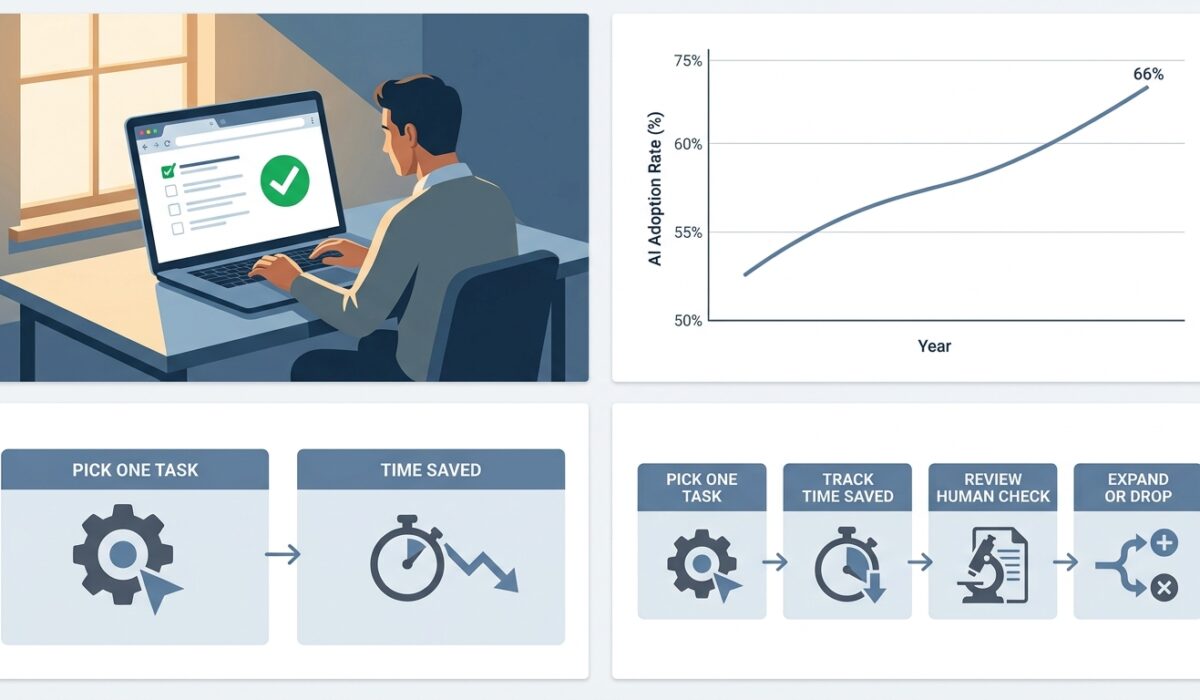
- U.S. small business AI adoption reached 66% in 2026, up from 55% the year before, according to Thryv’s 2026 AI and Small Business Adoption Survey.
- The businesses seeing measurable ROI are the ones automating one specific task first, then expanding, not the ones rolling out AI across every department at once.
What Drovenio AI for Business Actually Is
Search this term and you will find two completely different stories. One set of articles, the more carefully checked ones, describes Droven.io accurately as a content site publishing explainer articles on AI, automation, and digital transformation, aimed at general business readers. The other set describes a fully featured “AI-powered analytics platform” with real-time dashboards, machine-learning-as-a-service capabilities, and cross-department automation. Both cannot be true.
The verification test settles it quickly. A real AI vendor has a pricing page, a signup flow, and usually at least one listing on a review site like G2, Capterra, or Trustpilot, even a new one. None of that exists for “Drovenio” as a product. What exists is a blog. Once that is established, there is no product to evaluate, no benchmark to run, and no pricing trap to warn readers about, because none of it applies to something that was never built to be purchased.
The practical takeaway for anyone who landed on this search term is simple: if you came looking for a tool, redirect your evaluation toward actual AI vendors relevant to your task (customer service platforms, marketing automation tools, coding assistants), and treat any article describing “Drovenio’s dashboard” or “Drovenio’s automation engine” as inaccurate. What follows here is a grounded look at how small businesses are actually using AI in 2026, based on verified survey data rather than invented product features.
Where Small Business AI Adoption Actually Stands in 2026
The numbers moved fast. Thryv’s 2026 AI and Small Business Adoption Survey, covering 561 small and mid-sized business owners, found adoption at 66%, up from 55% a year earlier, with roughly a third of businesses spending more on AI tools than they did twelve months prior. Seventy percent of respondents said AI increased revenue over the past year, and 55% said it helped cut costs.
A separate data point worth noting: Federal Reserve research published in April 2026 found that small businesses had started adopting AI faster than large enterprises, a reversal from the historical pattern where big companies with dedicated IT budgets moved first. That shift traces mostly to cost. Tools that once needed a data science team now run on a monthly subscription that a solo founder can approve without a budget meeting.
None of this means adoption is uniform or effortless. The same Thryv survey found 70% of owners admitting they need more training to use AI tools effectively, which tracks with what shows up in practice: businesses buy a tool, use a fraction of its capability, and never measure whether it actually paid for itself.
Practitioner Tip:
Before subscribing to any AI tool, write down the specific task it will replace and how long that task currently takes. Revisit that note after 30 days. If you cannot say clearly how much time or money the tool saved, you are paying for a habit, not a result, and that is the single most common way small AI budgets get wasted.
The Highest-Return Places to Start
Customer service and marketing consistently show up as the functions where small businesses see the fastest, clearest returns, mainly because the tasks involved (answering common questions, drafting first-pass copy, summarizing customer feedback) are repetitive, well-defined, and easy to measure against a before-and-after baseline.
Coding and technical work follow a similar pattern for SaaS founders specifically. Code-completion and review assistants shorten routine implementation work, though the gains depend heavily on codebase quality; a messy, undocumented codebase gets much less benefit than a well-structured one, because the AI has less reliable context to work from.
Operations and scheduling tasks (routing support tickets, drafting meeting summaries, flagging anomalies in basic reporting) tend to produce smaller but more consistent gains. They rarely make for an exciting case study, but they compound, because they run every single day rather than during a single campaign.
| Business Function | What AI Handles Well | Typical Time to Measurable Result | Where It Falls Short |
|---|---|---|---|
| Customer service | First-response drafting, common-question triage | 2 to 6 weeks | Complex complaints still need a human |
| Marketing and content | First drafts, A/B copy variants, summarization | 2 to 4 weeks | Brand voice consistency needs editing |
| Software development | Code completion, review assistance, test scaffolding | 4 to 8 weeks | Weak on undocumented or messy codebases |
| Operations and admin | Scheduling, summarizing, basic anomaly flags | 1 to 3 months | Struggles with judgment-heavy exceptions |
Where Businesses Get This Wrong
The most common mistake is starting broad. A founder decides the company needs “an AI strategy,” buys three or four tools across departments in the same month, and six months later cannot say which one actually helped, because nothing was measured in isolation. Isolated, single-task rollouts are boring, but they are the only way to know what is actually working.
The second mistake is skipping training, which the 70% figure above points to directly. A tool bought and never properly onboarded gets used at a fraction of its potential, and the team quietly reverts to the old manual process within a few months, while the subscription keeps renewing.
The third mistake is treating AI output as final rather than a draft. This matters most for anything customer-facing. Teams that keep a human reviewing AI-generated replies, marketing copy, or reports catch errors before a customer sees them. Teams that automate the review step away entirely tend to discover the failure only after a customer complains, which is a far more expensive way to find out.
A Realistic 90-Day Adoption Plan
Weeks one and two should go entirely to picking one task and one tool, not evaluating five options across five departments. Pick the task with the clearest current cost, whether that is hours spent answering repeat customer questions or time spent drafting first-pass marketing copy.
Weeks three through six are for actual use, with someone tracking time saved or output produced against the pre-AI baseline. This is also the point where training gaps show up. If the team is not using half the tool’s features by week four, that is worth a short internal session rather than assuming adoption will happen on its own.
By week eight or nine, you should have a real number: hours saved, cost avoided, or output increased. That number decides whether to expand to a second task or drop the tool. Expanding without that number is how businesses end up with four AI subscriptions and no clear idea which one is earning its cost.
The Bottom Line
If the search that brought you here was about a product called Drovenio, there is nothing to sign up for. What actually helps is what the 2026 adoption data keeps showing: pick one narrow, measurable task, keep a human reviewing anything customer-facing, and track real time or cost saved before expanding further. That approach, not any single platform or article, is what separates businesses seeing a genuine return from the ones paying for tools nobody is using well.