
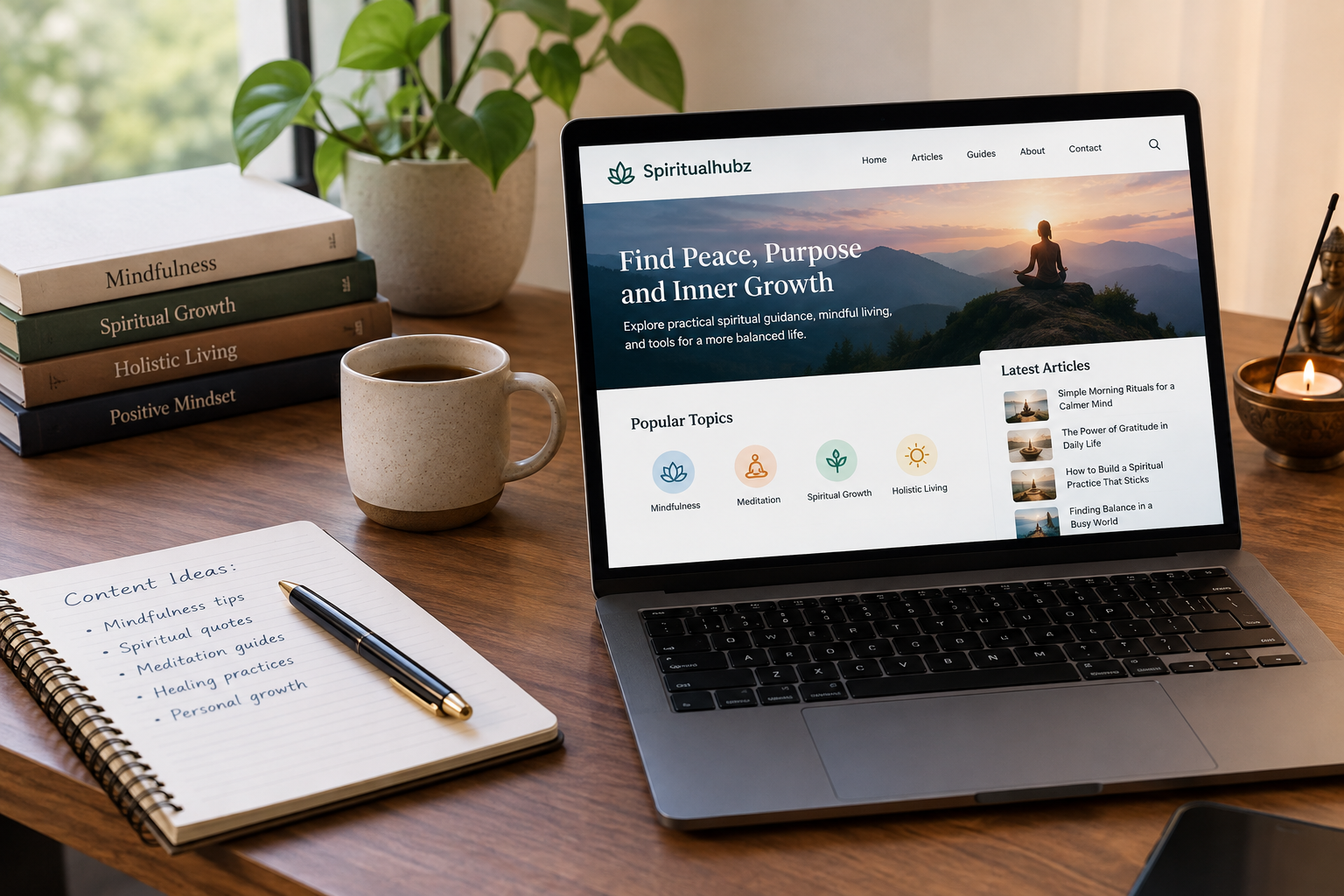
A domain like spiritualhubz.com makes a promise before anyone reads a word. “Hub” says readers will find many things in one place. “Spiritual” sets a gentle tone. The “USA” in the keyword adds a third promise: the content fits American readers and American search habits.
Keeping all three promises is harder than it looks. This guide covers the audience data, topic choices, trust pages, tool costs, and money traps that decide whether a spiritual site grows or stalls.
QUICK ANSWER
Spiritualhubz.com USA is best treated as a niche brief: a spiritual content hub aimed at American readers. Pew Research’s 2023-24 Religious Landscape Study found that nearly three-quarters of US adults call themselves at least somewhat spiritual, and 21% say they are spiritual but not religious. That is a big audience with weak brand loyalty. A site wins here with first-hand authorship, plain claims, fast pages (largest content paint under 2.5 seconds), clear disclaimer and affiliate pages, and one narrow topic cluster such as meditation or ritual practice. Broad “everything spiritual” sites lose to focused ones. Budget roughly $30 to $120 a month at launch.
KEY TAKEAWAYS
- Audience size: About three in four US adults describe themselves as at least somewhat spiritual, so demand exists. Loyalty is the scarce part.
- Focus: One cluster of 25 to 40 articles beats 200 scattered posts. Search engines read depth as authority.
- Trust: Disclaimer, author, and affiliate disclosure pages are ranking and conversion assets. Build them before post number five.
What the Keyword Tells You About Search Intent
People who type “spiritualhubz.com usa” usually fall into two groups. The first group knows the brand and wants the site itself. The second group is a publisher or founder studying the idea. This article speaks to the second group.
For a branded phrase, the ranking page is nearly always the site’s own homepage. You cannot outrank a site for its own name with a blog post. The smarter play is to rank for the topics around the brand, then let the name grow from that traffic.
The “USA” modifier matters more than it seems. It tells Google the reader wants results relevant to the United States: US spelling, US holidays, US shipping for any products, and FTC-style disclosure. Set your site language to English (US) and mention American examples early in each article.
Spiritual searches also split into learning (“what is a chakra”), doing (“how to start a morning meditation”), and buying (“best meditation cushion”). Each type needs a different page layout. Mixing them on one page confuses readers and crawlers.
The US Audience Is Large and Hard to Hold
The numbers reward a close read. In the 2023-24 Religious Landscape Study, Pew Research spirituality survey results show that Americans are more likely to call themselves spiritual than religious. Nearly three-quarters say they are very or somewhat spiritual, while 58% say they are very or somewhat religious. Among people with no religious affiliation, 37% say they are spiritual but not religious.
This shapes your content in a practical way. Many of your readers have no congregation and no single teacher. They assemble a practice from articles, apps, and videos. That makes them curious and quick to leave. If your article answers the question in the first two paragraphs and points to a logical next step, they stay. If it opens with 400 words of scene-setting, they go.
Do not write for one reader type. A churchgoer who meditates, a former churchgoer who follows astrology, and a lifelong yoga student all arrive through the same search results. Define terms plainly and never treat one tradition as the default.
Pick One Cluster Before You Pick a Design
Most new spiritual sites start with a logo, a palette, and a menu with ten categories. Then they publish three posts per category and wonder why nothing ranks.
Start with one cluster: 25 to 40 articles on a single topic, linked together, with one pillar page at the center. Good candidates include beginner meditation methods, journaling prompts, seasonal rituals, and mindful routines for work.
Check three things before committing. Search results for your main terms should show weak pages, such as thin listicles or outdated posts. The topic should allow personal experience, because first-hand writing is your edge over large publishers. And a product or service should plausibly fit the topic, even if you sell nothing for a year.
Keep a spreadsheet with the keyword, the intent, the current top three results, and what they miss. The “what they miss” column is your strategy. Maybe the top results never say how long a practice takes, or they assume daily free time most readers lack. Fill that gap and your page has a reason to exist.
Trust Pages and the Claims Problem
Spiritual content sits near sensitive territory. Readers may search while grieving, anxious, or ill. A careless line such as “this ritual will cure your insomnia” creates real risk for them and a credibility problem for you.
Google’s Google’s people-first content guidance asks whether a page shows first-hand experience and whether a reader would leave satisfied. It also warns against content made mainly to attract search traffic. For spiritual sites, those questions work as an editing checklist.
Set a claims policy and apply it to every post. Describe practices as practices. Write “many people find this calming” instead of “this reduces anxiety.” Never promise medical, financial, or relationship outcomes. When a topic touches health, add one plain sentence that the content is not medical advice.
Build these pages before your fifth article: an About page with real names, an editorial policy page, a disclaimer page, an affiliate and advertising disclosure, and a contact page with a working email address.
Google’s guidance on AI-assisted writing adds a rule: content should be fact-checked and reviewed before publishing, whoever or whatever drafted it. A human editor who checks every date, name, and statistic is a baseline requirement.
Pick a Stack You Can Afford to Keep
New publishers overspend in month one and cancel half their tools by month four. The table shows typical cost ranges for a small content site. Prices change often, so verify current plans before buying. Speed targets come from Google’s published Core Web Vitals thresholds.
| Tool / Criterion | Primary Strength | Benchmark / Speed Target | Typical Monthly Pricing |
|---|---|---|---|
| Managed WordPress hosting | Easy editing, large plugin pool | Largest content paint under 2.5 s | $10 to $35 |
| Static site plus headless CMS | Very fast pages, small attack surface | Under 1.5 s is realistic | $0 to $25 |
| Hosted site builder | Fast setup, no maintenance | Varies by template, test first | $15 to $40 |
| Email newsletter platform | Owned audience, direct reach | Track welcome email open rate | $0 to $50 at small list sizes |
| Privacy-friendly analytics | Simple traffic and source data | Adds little page weight | $0 to $20 |
No row fits every site. WordPress wins when several non-technical people edit content. A static setup wins when one technical person runs the site and speed comes first. Hosted builders save time early and cost flexibility later, since moving a large site off one is slow.
Two budget traps appear often. The first is the introductory hosting price that triples at renewal, so read the renewal rate before checkout. The second is the plugin pile: a dozen add-ons for sliders, popups, and feeds, each adding scripts. Start with a clean theme and add a plugin only when a specific problem demands it.
Speed and Accessibility Are Ranking Work
Core Web Vitals set three targets: largest content paint within 2.5 seconds, interaction responsiveness under 200 milliseconds, and layout shift under 0.1. Measure your pages on a mid-range phone over a normal mobile connection, since a fast laptop on office wifi hides real problems.
Spiritual sites usually fail speed tests because of heavy imagery. Soft-focus mountain photos and full-width banners weigh several megabytes. Compress images to modern formats, set explicit width and height so layouts do not jump, and lazy-load anything below the first screen. Leave autoplay music and video off the page.
Accessibility deserves equal attention, since many readers have low vision or older eyes. The W3C Web Content Accessibility Guidelines set the standard most organizations follow. Three fixes cover most problems: text contrast of at least 4.5 to 1, descriptive alt text on informative images, and link text that makes sense out of context. Pale gray text on cream backgrounds is a favorite in this niche and a frequent failure.
Where the Money Comes From, and Where It Goes Wrong
Spiritual sites earn from display ads, affiliate links, digital products, and paid memberships. Each has a trap.
Display ads need traffic. Most networks set visitor minimums, and revenue per thousand visits varies by topic and season. Expect little in year one. Ad scripts also hurt the speed work you just did.
Affiliate links pay well for cushions, journals, and courses, but they carry the highest trust risk. Recommend only what you have used, state the relationship near the link, and never rank products by commission rate. Readers can tell.
Digital products such as printable journals, guided audio, and short courses give the best margins. They need an audience that already trusts you, which is why the email list matters more than any traffic figure. Start collecting addresses on day one with one useful free download.
Paid memberships work only when they offer something live or personal: a monthly group session, direct feedback, a private community. Static content behind a paywall rarely survives.
One caution covers every model. Products that promise to “manifest wealth” or “heal trauma” attract refund requests and regulator attention. Describe what the product contains, not what it will do to the buyer’s life.
PRACTITIONER TIP
Before you publish a single article, set up Google Search Console and submit your sitemap. Check the “Pages” report weekly for the first two months. New sites often have posts stuck as “Discovered, currently not indexed,” and the cause is usually thin content or weak internal links, not a technical fault. Merge two thin posts into one stronger post, add links from your pillar page, and request indexing again.
A Publishing Workflow That Holds Up
A repeatable process protects quality when you are tired. Use the same steps for every article.
Write down the reader’s question and the single answer you will give. Collect your own notes: what you tried, how long it took, what went wrong. These notes are the part no competitor can copy. Draft with the answer in the first two paragraphs. Check every fact, link, and quotation against its original source. Add links to two or three related posts and one clear next step. Publish, then set a reminder to refresh the post after 90 days.
The refresh step is the one most publishers skip. Update statistics, replace dead links, and add what readers asked in comments or emails. Keep the author’s identity consistent too: a named writer with a short bio and a profile page gives readers and search systems something to evaluate. Posts under “Admin” give them nothing.
Common Mistakes to Skip
Publishing on too many topics at once is the most common mistake. Copying competitor outlines is the second. If your headings match the top three results, Google has no reason to prefer yours.
Another mistake is chasing every high-volume keyword. General astrology queries are dominated by large publishers with years of authority. Smaller phrases tied to a specific practice or situation rank sooner.
Last, many founders treat the first three months as a verdict. New domains take time to earn trust. Judge early progress by indexed pages, impressions in Search Console, and email sign-ups rather than raw traffic.
Conclusion
A spiritual content site wins on trust, focus, and speed. Pick one topic cluster, publish your About, editorial policy, disclaimer, and affiliate pages early, and choose hosting after reading its renewal price. Write each article from your own notes with the answer in the first paragraph. Test the homepage on a mid-range phone, fix layout shifts, and review your posts every 90 days.
The audience is there, since most Americans call themselves at least somewhat spiritual. Readers give their loyalty to small sites that say plainly what they know and what they do not. Build that trust page by page, and the keyword you started with can become a brand people search for by name.
Frequently Asked Questions
What is spiritualhubz.com USA?
It is a search phrase that combines a site name with a US audience tag. I could not verify details about the site itself, so check it directly before drawing conclusions. This article treats the phrase as a brief for a US-focused spiritual content hub.
How many Americans describe themselves as spiritual?
Pew Research’s 2023-24 Religious Landscape Study found that nearly three-quarters of US adults say they are very or somewhat spiritual. About 21% say they are spiritual but not religious, and 58% say they are very or somewhat religious.
How much does it cost to launch a spiritual content site?
A small site usually runs between $30 and $120 a month for hosting, email, and analytics. That range is an estimate. Check current plan prices and renewal rates before you commit.
Can I use AI to help write the articles?
Google says it looks at the quality of content, not how it was produced. Its documentation also says AI-assisted content should be fact-checked and reviewed before publishing. Add your own first-hand notes, because generic drafts give readers nothing new.
How long does it take to rank?
No one can promise a timeline. Many new domains see slow movement for the first six months. Track indexed pages and Search Console impressions to see whether you are on the right path.
Is it safe to make health claims on a spiritual site?
Avoid them. Describe practices and what people report about them, add a short not-medical-advice note where relevant, and send readers with health concerns to a qualified professional.