Quick Answer
Drovenio latest technology news is a search phrase attached to a cluster of AI-generated articles across multiple unrelated websites, not a single verifiable, established news publication. None of the pages using this name show the markers of a real outlet: no consistent domain, no named editorial staff, no company registration record, and no independent citation from established tech press. Readers searching this term are usually looking for general updates on AI, cybersecurity, cloud computing, and emerging hardware, which are covered reliably by established outlets and primary sources instead.
Anyone who has spent time checking sources for a living develops a habit: before repeating a claim, find out who is actually behind it. Run that check on “Drovenio” and the trail goes thin fast.
Why This Name Shows Up Everywhere and Means Nothing Consistent
Search for the phrase and dozens of near-identical articles appear across different domains: drovenio.org, drovenio.blog, forgearticles.com, techoldnewz.co.uk, business5stars.com, definesyntax.com, techflixer.com. Each one describes “Drovenio” slightly differently: an editorial hub, an AI news source, a market-updates blog, an automation software company.
That inconsistency is itself the signal. A real publication has one identity across the web: a consistent domain, a masthead, named writers, an about page that does not contradict itself from site to site. When the description of a “brand” changes shape depending on which copy-paste article you land on, you are not looking at a publication. You are looking at a keyword that content farms latched onto because it generates search traffic.
One of the more candid entries in this cluster admits as much directly, stating there is no independently verifiable software product operating under the Drovenio name, and no pricing page, support documentation, or company registration details of the kind a real vendor typically publishes.
What People Searching This Term Are Actually Looking For
Strip away the brand confusion and the underlying interest is straightforward. People typing this phrase want current, readable updates on a handful of recurring tech themes: artificial intelligence, cybersecurity, cloud computing, and next-generation connectivity. Those topics are real and worth covering. They just deserve sourcing that holds up.
Artificial Intelligence: Where the Real Shift Is Happening
 The most substantive change in AI right now is the move from single-response chatbots to systems that plan and execute multi-step tasks with limited human input, often called agentic AI. Instead of answering one prompt, these systems break a goal into steps, call external tools, and adjust based on results.
This shift is showing up in enterprise software rather than consumer apps first. Companies are piloting AI agents for customer support triage, internal data analysis, and parts of software testing, with mixed results depending on how well the task is scoped. A narrow, well-defined task tends to work. A vague, open-ended one still needs a human checking the output at every stage.
Anthropic’s own documentation on building and evaluating AI agents lays out this same trade-off directly: agent reliability depends heavily on how clearly a task is bounded, not just on the underlying model’s raw capability.
Cybersecurity: The Practical Baseline Has Moved
 Zero trust security models, where no device or user is automatically trusted regardless of network location, have gone from a specialist term to a standard recommendation for any organization handling sensitive data. The National Institute of Standards and Technology publishes detailed guidance on zero trust architecture that most enterprise security teams now treat as a baseline reference rather than an advanced option.
Multi-factor authentication and endpoint detection tools are no longer optional add-ons in most serious security postures. The practical trade-off worth knowing: stronger authentication reduces account takeover risk significantly, but it also increases support load, since locked-out users generate real ticket volume. Teams that roll out MFA without planning for account recovery flows tend to regret it within the first month.
Practitioner Tip
Before adopting any AI agent tool in a production workflow, run it on a task with a known correct answer first. If it gets that wrong silently, you have no way to trust it on a task where you do not already know the answer.
Cloud Computing and Edge Processing
 Edge computing, processing data closer to where it is generated rather than routing everything to a central data center, keeps growing because latency-sensitive applications cannot tolerate a round trip to a distant server. Autonomous vehicles, industrial sensors, and real-time healthcare monitoring are the clearest examples where a few hundred milliseconds of delay is not a minor inconvenience.
The trade-off rarely gets mentioned in marketing copy: edge deployments are harder to secure and patch consistently than a single centralized data center, because you are managing security across many distributed nodes instead of one location.
Comparing Real Tech Trends Worth Tracking
| Trend | What Changed Recently | Practical Trade-off |
|---|---|---|
| Agentic AI | Systems now plan and execute multi-step tasks | Works well on narrow tasks, unreliable on vague ones |
| Zero trust security | Moved from advanced option to standard baseline | Stronger security, higher support and setup overhead |
| Edge computing | Growing for latency-sensitive applications | Faster response times, harder to secure at scale |
| Multimodal AI | Single systems now handle text, image, and audio together | Reduces tool-switching, increases compute cost per task |
How to Vet a Tech News Source Before Trusting It
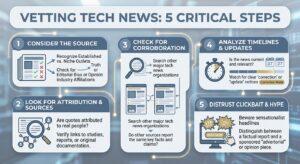 Check whether the site has a real, consistent domain with an about page that matches its content across time. Look for named authors with a traceable history, not generic bylines like “admin” or “editorial team” on every post. Cross-check any specific claim, especially statistics, against an original source rather than another blog repeating the same number.
If a site’s own content contradicts itself about what it is (a news outlet on one page, a software company on another), treat that as a clear signal to look elsewhere for the actual information.
Key Takeaways
Drovenio latest technology news is a search phrase tied to a scattered content-farm cluster, not one verifiable news publication with a consistent identity. The genuine tech trends worth following, agentic AI, zero trust security, and edge computing, are better tracked through primary sources and established outlets with a traceable editorial history. Checking a source’s consistency across its own pages takes a few minutes and catches most of these situations before you cite something unreliable.
Final Thoughts
The tech topics behind this search term are real and worth understanding. The brand attached to the search term is not something to cite or trust as an authority. Readers get better information going straight to the primary sources, standards bodies, and established outlets already covering AI, security, and cloud computing with a track record that holds up to a basic background check.