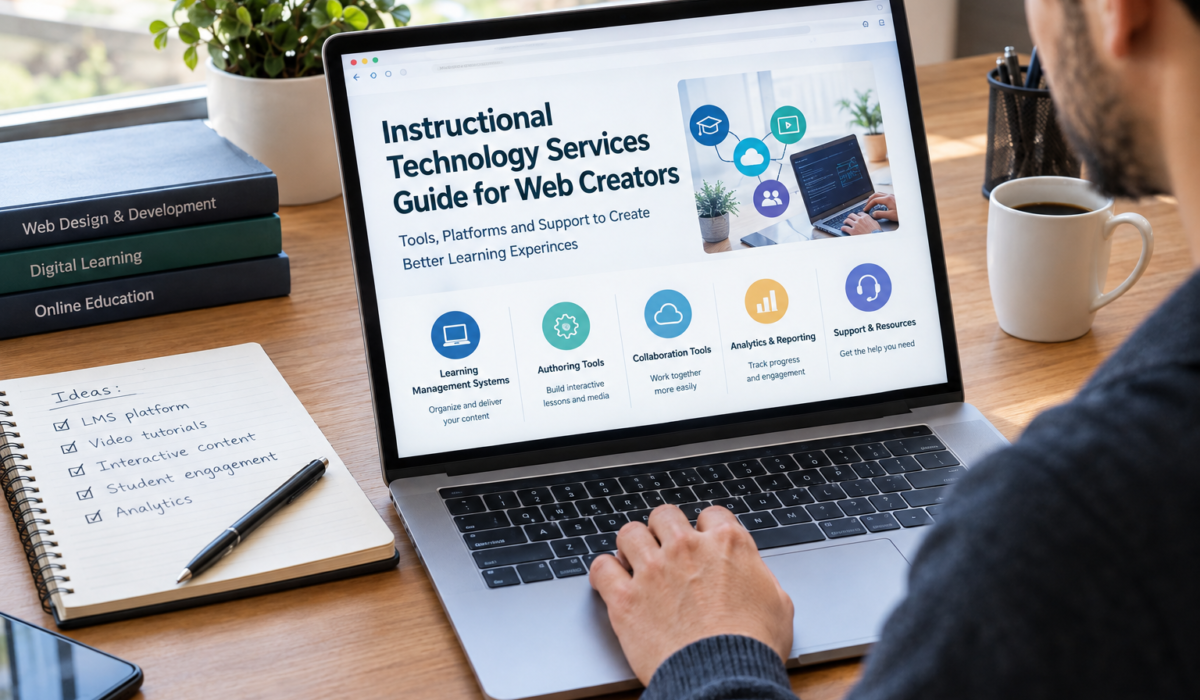
A founder once sent me a quote for a course platform setup. It was $14,000 for something a single freelancer could have configured in a week. Nobody in the room could say what half the line items meant.
That is the usual problem with instructional technology services. The label sounds official, the scope is vague, and the price swings wildly between vendors. This guide sorts out what the services actually are, what they cost, and which ones a small team can skip.
Quick Answer
Instructional technology services are paid support for building, running, and improving digital learning products. They cover learning management system (LMS) setup, course and media production, tool integrations, accessibility work, analytics, and ongoing technical support. Costs vary by scope: a basic platform setup usually runs a few hundred to a few thousand dollars, custom integrations and course production can reach five figures, and managed support often bills monthly. Buyers should confirm four things before signing: which standards the platform supports (such as LTI), whether the work meets WCAG accessibility criteria, who owns the learner data, and what the second-year cost will be.
Key Takeaways
- Scope first: Write down the learning goal and the tools involved before requesting any quote. Vague briefs produce inflated estimates.
- Standards protect you: Platforms that support LTI and similar standards let you swap tools later without rebuilding courses.
- Accessibility is a requirement: Aim for WCAG 2.2 AA on every course page and video. Retrofitting costs far more than building it in.
- Year two is where costs hide: Hosting, support, and per-learner fees often exceed the setup price within 18 months.
What Instructional Technology Services Cover
The term comes from education, where schools and universities hire specialists to help teachers use digital tools. The same work now happens in commercial settings. A SaaS company building a customer academy needs it. A publisher selling paid courses needs it. An independent creator running a membership site needs a lighter version of it.
At its core, the service answers one question: how does a learner get from “I signed up” to “I finished and learned something” with as little friction as possible? Everything else is a means to that.
Providers sell this in different shapes. Some are agencies that build everything. Some are consultants who advise and let your team execute. Others are software vendors who bundle setup and support into a subscription. Knowing which shape you are buying matters, because each one fails in a different way.
Who Actually Needs These Services
Not every site needs them. If you sell one video course through a hosted platform that handles payments, hosting, and delivery, you probably need none of this. The platform is the service.
The need appears when one of three things happens. Your learners require tracking beyond “watched or not watched.” Your course must connect to other systems, such as a CRM, a billing tool, or a single sign-on provider. Or your content has grown past what one person can maintain.
SaaS founders hit this wall when customer onboarding turns into a product of its own. Publishers hit it when subscribers ask for certificates or progress reports. Independent creators hit it when a hobby course becomes a business with refund disputes and support tickets.
The Five Service Categories
1. Platform setup and configuration
This covers choosing and installing an LMS, setting up user roles, building the course catalog structure, and connecting payments. The work is mostly configuration, not invention. A competent practitioner can complete a standard setup in days.
The trap is customization. Every request to change default behavior adds hours and creates something you must maintain through every update.
2. Course and media production
Scripting, recording, editing, quiz design, and visual layout belong here. This is usually the most expensive category per hour and the one where quality varies most.
Ask for a finished sample lesson before you commit. A strong portfolio piece tells you more than any pitch deck. Check that the audio is clean, the pacing fits the subject, and the quizzes test understanding instead of recall of trivia.
3. Integrations and standards
This is where technical depth matters. Learning platforms exchange data with other tools through standards. The most common is Learning Tools Interoperability, which lets an external tool launch inside your LMS and send results back. The 1EdTech LTI standard overview explains how the specification works and which versions exist.
Platforms that support open standards cost less to leave. Platforms built on closed, proprietary connections keep you tied to one vendor, and the exit bill can be larger than the original build.
4. Accessibility and compliance
Captions, keyboard navigation, color contrast, and screen reader support are baseline requirements. The W3C Web Content Accessibility Guidelines define the success criteria most organizations and regulators use. Some buyers, especially anyone selling to schools, governments, or large companies, will ask for an accessibility report before purchase.
Treat this as a build step, not a final polish. Adding captions and fixing contrast after launch means touching every lesson twice.
5. Analytics, support, and maintenance
Once the course is live, someone has to read the data, fix broken links, answer learner questions, and apply software updates. Many vendors sell this as a monthly retainer.
The useful question is what the retainer includes in hours, not in adjectives. “Priority support” means nothing until the contract states a response time.
How the Options Compare
| Service type | Primary strength | Typical timeline | Rough cost range |
|---|---|---|---|
| Hosted course platform (self-serve) | Fastest launch, low upkeep | Hours to 2 days | $0 to $300 monthly |
| LMS setup by a freelancer | Custom structure, fair price | 3 to 10 days | $500 to $3,000 one time |
| Agency full build | Design, content, and tech in one place | 6 to 16 weeks | $8,000 to $40,000 or more |
| Course production only | Polished video and quizzes | 2 to 8 weeks | $1,500 to $10,000 per course |
| Managed support retainer | Ongoing fixes and updates | Continuous | $300 to $2,500 monthly |
| Accessibility audit and fixes | Compliance and wider reach | 1 to 4 weeks | $1,000 to $6,000 |
These ranges come from quotes and project budgets I have seen across small and mid-size projects. Treat them as a starting point for questions, not a price list. Your region, scope, and provider will move the numbers.
The Pricing Traps Worth Knowing
Most overspending comes from a few predictable places.
Per-learner pricing. A platform that charges per active user looks cheap at 100 learners and painful at 10,000. Ask for the price at ten times your current volume. If the number scares you, the plan will not scale.
Setup fees that repeat. Some vendors charge a new setup fee for every course or every client portal. Read the contract for the word “additional” and see what follows it.
Custom code with no documentation. A custom plugin built by one developer is a risk if that person leaves. Require documentation and source access in the agreement.
Bundled content you cannot export. If your videos, quizzes, and learner records live in a format only the vendor can read, you have bought a lock-in, not a service. Ask for a sample export before signing.
Support tiers that gate basic fixes. A broken payment button should never sit behind a premium plan.
Practitioner Tip
Before you pay a deposit, ask the vendor to export one complete course, including media, quiz data, and a sample learner record, into a standard format and send it to you. A vendor who agrees quickly has built an open system. A vendor who stalls, or asks for a fee, has just told you what leaving will cost. I have used this single request to rule out three providers in under a week.
How to Evaluate a Provider
Skip the brand names and look at evidence.
Start with a working sample. Ask to see a live course the provider built, and enroll in it yourself. Notice load time, mobile behavior, and what happens when you fail a quiz. These small experiences reveal more than a case study PDF.
Next, check the integration list against your real stack. If you use a specific payment tool, email platform, or CRM, confirm that the connection exists and who maintains it. “Custom integration available” often means a billable project.
Then test their answers on data. Where is learner data stored, who can access it, and how fast can it be deleted on request? Privacy rules in many regions require clear answers, and a vague reply is a bad sign.
Finally, talk to a past client. One honest reference call can reveal missed deadlines and surprise invoices that never appear in marketing copy.
Build Versus Buy
Small teams often assume they must choose between building everything and outsourcing everything. The better option is usually a split.
Buy the commodity parts. Hosting, payments, video delivery, and quiz engines are solved problems, and rebuilding them wastes time. Build or control the parts that make your product different: the curriculum, the learner experience, and the data you collect.
A SaaS company running a customer academy might use a hosted LMS for delivery and a contractor for custom reporting inside its own dashboard. A publisher might outsource video production and keep editorial control of every lesson. An independent creator might hire a freelancer for a one-time setup and handle the content alone.
This split keeps costs predictable and keeps your content portable.
Why This Matters for Search and Discovery
Learning content also needs to be found. Course landing pages, lesson summaries, and help articles are all indexable pages, and they follow the same quality rules as any other content. Google’s guidance on <a>creating helpful, people-first content</a> applies directly: original information, clear purpose, and visible expertise.
Many course platforms hide lesson content behind logins, which makes sense for paid material. Create public pages for the topics you teach, such as syllabus overviews, sample lessons, and answers to common questions. Those pages bring in learners, while the platform handles everyone after signup.
Common Mistakes
Buying a platform before defining the learning goal. Teams pick software based on a demo and then discover it cannot do the one thing they needed.
Ignoring mobile. A large share of learners open lessons on phones. Test every lesson on a mid-range device with a slow connection.
Overbuilding the first version. Launch with one strong course and basic tracking. Add certificates, forums, and gamification only after learners ask for them.
Skipping learner feedback. Completion rate tells you who finished. It does not tell you who learned. Add a short survey and a practical exercise at the end.
Treating launch as the finish line. Courses age. Screenshots go stale, links break, and software versions change. Budget a few hours monthly for upkeep from day one.
Final Thoughts
Instructional technology services are worth buying when they remove a specific problem: tracking you cannot do, integrations you cannot build, or content you cannot produce in time. They are a waste when they fill a gap you have not defined.
Start with the learner outcome. Pick the cheapest setup that reaches it. Insist on open standards, accessible content, and clean data exports. Then review the numbers every quarter and spend more only where the data supports it.
Frequently Asked Questions
What are instructional technology services in simple terms?
They are paid services that help you build, run, and improve digital learning products, including platform setup, course production, integrations, accessibility, and support.
How much should a small creator spend?
Most small creators do well with a hosted platform and, at most, a one-time freelancer setup. Spending five figures before you have paying learners is rarely justified.
Do I need an LMS?
If you sell a few courses and need simple delivery and payments, a hosted course platform is enough. An LMS makes sense when you need user groups, detailed reporting, or integrations with other business systems.
What standards should I look for?
LTI for tool connections is the main one for most buyers. Ask the vendor which versions they support. For accessibility, ask about WCAG 2.2 AA.
How long does implementation take?
A basic setup takes days. A custom build with integrations and original content takes two to four months.