Quick Answer
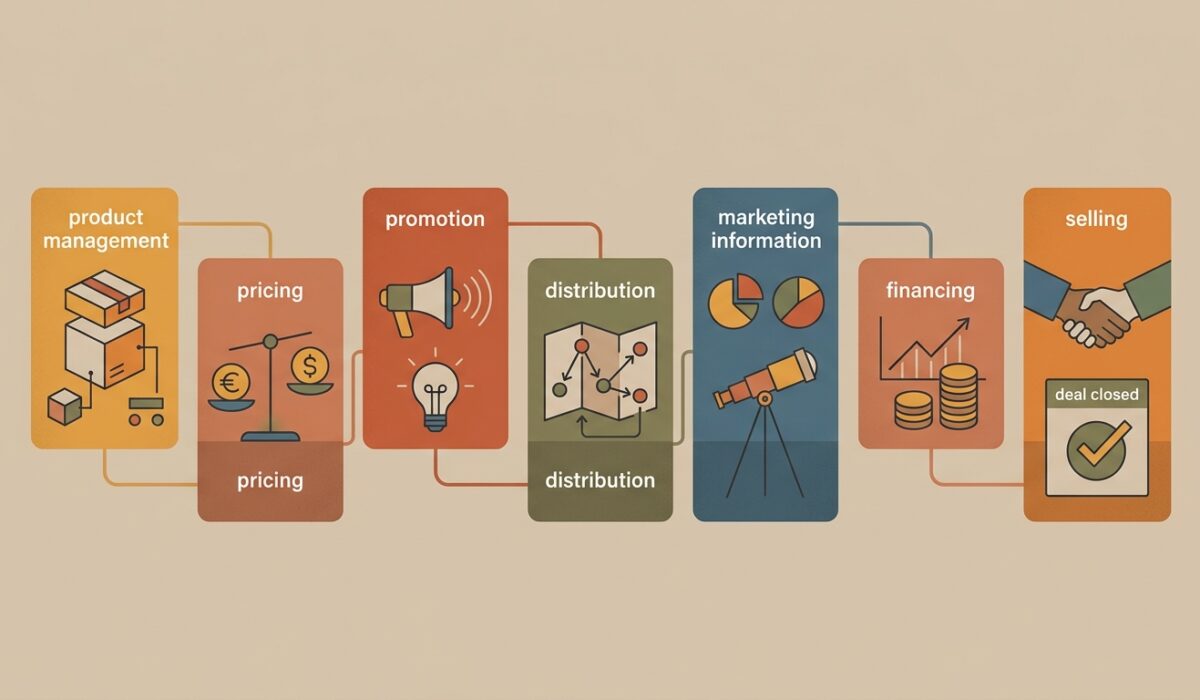
The 7 functions of marketing are product and service management, pricing, promotion, distribution, selling, marketing information management, and financing. Product management decides what you offer and how it improves over time. Pricing sets what customers pay. Promotion tells people the offer exists. Distribution puts it where buyers can get it. Selling turns interest into a paid order. Marketing information management collects the customer and market data that guides every other decision. Financing covers the money needed to run campaigns and, in some businesses, the credit offered to buyers. A weak function drags down the other six, so audit all seven before you spend more on ads.
Key Takeaways
- Seven functions, one system: Product, pricing, promotion, distribution, selling, information, and financing work as a chain. If one link breaks, the rest lose value.
- Promotion is only one piece: Most creators spend nearly all their effort on promotion and neglect pricing and market research, which often cost less to fix.
- Data comes first: Marketing information management should guide the other six. Decisions made without it are guesses.
Most small teams think marketing means posting content and running ads. That is one function out of seven. The other six decide whether those ads bring in money or just traffic.
I have seen creators publish for a year, grow an audience, and still earn almost nothing. The content was fine. The pricing was unclear, the checkout was clumsy, and nobody had asked readers what they wanted to buy. Each of those is a marketing function, and each one was ignored.
This guide explains all seven functions in plain terms, shows how they apply to web creators, SaaS founders, and digital publishers, and points out the mistakes that cost the most.
What Is Marketing, Exactly?
The American Marketing Association defines marketing as the activity and set of institutions for creating, communicating, delivering, and exchanging offerings that have value for customers and society. You can read the full wording in the American Marketing Association definition of marketing.
Look at the verbs in that definition: creating, communicating, delivering, exchanging. They map directly onto the seven functions. Creating is product management. Communicating is promotion. Delivering is distribution. Exchanging involves pricing, selling, and financing. Understanding the customer underneath all of it is what marketing information management does.
Textbooks list the functions in slightly different ways. The seven-function version below is the most common one in business courses, and it fits digital businesses well.
The 7 Functions at a Glance
| Function | Core Question It Answers | Digital Example | Common Failure |
|---|---|---|---|
| Product and service management | What are we selling, and is it good enough? | Adding a feature or a new course module | Building without asking customers |
| Pricing | What should customers pay? | Choosing monthly versus yearly plans | Copying competitor prices blindly |
| Promotion | How do people find out about us? | SEO, email, social, paid ads | Spending only on traffic, not on conversion |
| Distribution | How does the offer reach the buyer? | App stores, your website, marketplaces | Making the buying path too long |
| Selling | How does interest become an order? | Sales page, demo call, checkout | No clear next step for the visitor |
| Marketing information management | What do customers and the market tell us? | Analytics, surveys, search data | Collecting data and never reading it |
| Financing | How do we fund marketing and payment terms? | Ad budget, installment plans | Running out of cash mid-campaign |
Each function gets its own section below.
1. Product and Service Management
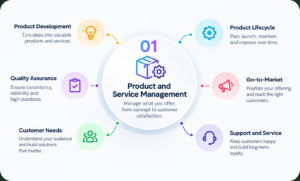
This function decides what you sell and how it changes. It covers features, quality, packaging, branding, and support. For a publisher, the product is the content plus the experience of reading it. For a SaaS founder, it is the software plus onboarding and customer service.
Product management also includes retiring things. An old feature nobody uses still costs maintenance time. A newsletter with falling open rates may need a new format or an end date.
The mistake I see most often is building first and asking later. A founder spends four months on a feature, launches it, and hears nothing. A short survey or five customer calls before development would have shown the gap in a week.
Practical step: Once a quarter, list every feature or content series you offer. Next to each, write who uses it and what it earns. Cut or fix the bottom third.
2. Pricing
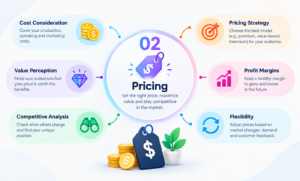
Price is the only function that directly produces revenue. Everything else costs money. Yet pricing is often set once, at launch, and never tested again.
A price sends a message. A very low price can suggest low quality. A high price can suggest a premium product, but only if the rest of the experience matches. Your price also has to cover costs, including the ones that hide in the background such as payment processing fees, refunds, support time, and hosting.
Common pricing models for digital businesses include one-time purchases, monthly subscriptions, annual plans with a discount, usage-based billing, and free tiers that lead to paid upgrades. Each has a trap. Free tiers attract users who never pay. Usage-based billing makes revenue hard to forecast. Annual discounts improve cash flow but can hurt if customers demand refunds late in the year.
Practical step: Test your price on new visitors only, never on existing customers, and change one thing at a time. A test with three changes at once teaches you nothing.
3. Promotion
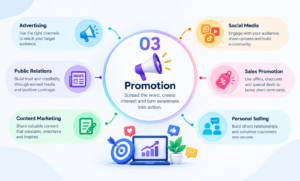
Promotion is how people learn you exist. It includes advertising, content marketing, search optimization, email, social media, public relations, and partnerships.
Web creators usually lean on organic search. Google states clearly that it rewards content made for people first. Its guidance on creating helpful, people-first content is worth reading before you plan any content calendar, because it explains what the search engine tries to reward.
Promotion works best when it matches the buyer’s stage. Someone who has never heard of you needs education. Someone comparing three tools needs proof, such as case studies and clear pricing. Someone who already has a cart open needs a nudge and a simple checkout.
The trap is measuring the wrong thing. Traffic is easy to count and easy to celebrate. Revenue per visitor is harder to measure and far more useful.
Practical step: Pick one channel and track it to revenue, not just clicks. Add a second channel only after the first one pays for itself.
4. Distribution
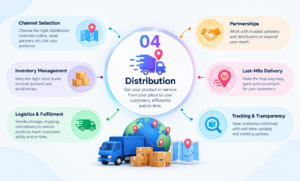
Distribution is how your offer reaches the buyer. In physical retail this means trucks and warehouses. For digital products it means the places where people can find, buy, and use what you make.
Your own website is one channel. App stores, marketplaces, affiliate partners, reseller programs, and integrations with other software are others. Each has a trade-off. A marketplace gives you instant reach but takes a commission and controls the customer relationship. Your own site gives you full control but you must bring all the traffic yourself.
Friction matters here. Every extra click, form field, or account requirement between interest and purchase loses some buyers. Distribution is partly a design problem.
Practical step: Buy your own product as if you were a stranger. Count the steps. Remove any step that does not help the customer or protect you from fraud.
5. Selling

Selling is the moment interest becomes an order. For some businesses this is a sales team on calls. For most creators it is a sales page, an email sequence, and a checkout.
Good selling starts with clarity. A visitor should understand within a few seconds what you offer, who it is for, and what happens next. Vague headlines lose to specific ones. “Project software for small teams” beats “Work smarter together.”
Trust also lives here. Reviews, refund policies, clear contact details, and visible security signs reduce hesitation. If you sell high-priced software, a demo or trial matters more than any headline.
The trap is pushing too hard before you have earned attention. A pop-up that appears in the first second annoys readers who came for information.
Practical step: Give every page one primary action. If a page asks visitors to subscribe, buy, share, and follow all at once, most will do none.
6. Marketing Information Management
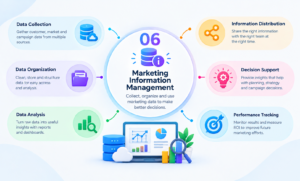
This function gathers, stores, and studies information about customers, competitors, and the market. It is the memory and eyesight of the whole system.
The data comes from several places: web analytics, search query reports, customer surveys, support tickets, sales conversations, and competitor research. The U.S. Small Business Administration explains the basics well in its guide to market research and competitive analysis, which is useful even for one-person businesses.
Most creators have plenty of data and little insight. Dashboards fill up while decisions stay the same. The fix is to start with a question, not a report. Ask “Why do visitors leave the pricing page?” and then look for the data that answers it.
Support tickets are underrated. Customers describe their problems in their own words, and those words make excellent headlines and product ideas.
Practical step: Once a month, read twenty customer messages in a row. Write down repeated phrases. Use them in your copy and your roadmap.
7. Financing
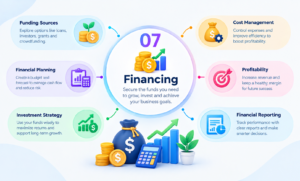
Financing has two sides. The first is funding your own marketing: ad budgets, tools, freelancers, and content production. The second is helping customers pay, through installments, payment plans, or invoicing terms.
Cash flow is where small businesses get hurt. A campaign might pay for itself in ninety days, but you pay the ad platform today. If you cannot survive the gap, the campaign fails even when the math works.
Customer financing has its own costs. Installment plans can raise conversions on higher-priced products, but they add processing fees and the risk of missed payments. Check the fee structure of any payment provider carefully before you offer it.
Practical step: Before launching a campaign, write down the maximum you can lose without hurting the business. Set your budget cap below that number and review spending weekly.
Practitioner Tip
Run a quick audit by scoring each of the seven functions from one to five on your own site. Be honest. The lowest score is your next project, not the one you enjoy most. Creators tend to keep improving their favorite function, usually promotion or product, while a low score in pricing or information management quietly limits growth.
How the Seven Functions Work Together
The functions depend on each other. Information tells you what customers want, which shapes the product. The product and its costs set the price range. The price and audience decide which promotion channels make sense. Distribution and selling decide how many interested people become buyers. Financing keeps the whole thing running while results build.
A change in one function ripples through the rest. Raise your price and your promotion message must change, because you now need to show more value. Add a new distribution channel and your selling process may need adjusting. This is why treating marketing as “posting content” tends to disappoint.
Consider a small SaaS tool. Support tickets show that users struggle with setup (information). The team builds a guided onboarding flow (product). They move the free trial from fourteen to thirty days to give users time to finish it (pricing). They rewrite the homepage to mention easy setup (promotion) and shorten the signup form (distribution and selling). They cap ad spend until the new flow proves itself (financing). Every function moved, and each one supported the others.
Applying the 7 Functions to Different Businesses
Independent web creators. Your product is content or a digital download. Information management usually means watching search queries and reader emails. Pricing is often the weakest point, since many creators undercharge because they compare themselves to free content.
SaaS founders. Product and pricing carry the most weight, since churn and expansion revenue depend on them. Promotion tends to be a mix of search, content, and partnerships. Selling includes trials, demos, and onboarding.
Digital publishers. Your product is attention and trust. Distribution matters heavily, since search, social platforms, newsletters, and aggregators all send different audiences. Financing often means balancing ad revenue, subscriptions, and sponsorships.
Common Mistakes to Avoid
Treating promotion as the whole job. Traffic without a good product, fair price, and clear checkout is wasted effort.
Setting the price once. Markets change, costs change, and customers change. Review pricing at least twice a year.
Skipping research because the business is small. Small businesses benefit most from research, since they cannot afford expensive mistakes.
Ignoring the buying path. Every unnecessary step costs sales. Test it yourself regularly.
Running campaigns without a budget cap. Enthusiasm is not a financial plan.
Copying big brands. A large company can afford tactics that a small team cannot. Copy their principles, not their budgets.
Final Thoughts
The seven functions give you a checklist for the whole business. When results stall, do not simply add more promotion. Go through the list and find the weakest link.
Start with the audit from the practitioner tip. Score each function, pick the lowest one, and fix it this month. A small improvement in a neglected function usually returns more than a big push in the one you already do well.
Frequently Asked Questions
What are the 7 functions of marketing?
Product and service management, pricing, promotion, distribution, selling, marketing information management, and financing.
Which function is the most important?
None works alone, but marketing information management guides the others. Without it, you are guessing about products, prices, and channels.
Are the 7 functions the same as the 4 Ps?
They overlap but differ. The 4 Ps (product, price, place, promotion) are a planning framework. The 7 functions describe the actual work a business must perform, so they add selling, information, and financing.
Do small businesses need all seven?
Yes. A one-person business still sets prices, finds customers, delivers products, and manages money. The work is smaller, but it does not disappear.
Where should a beginner start?
Start with information. Talk to ten potential customers, look at your search data, and write down what people ask for. Then adjust product and pricing based on what you learn.