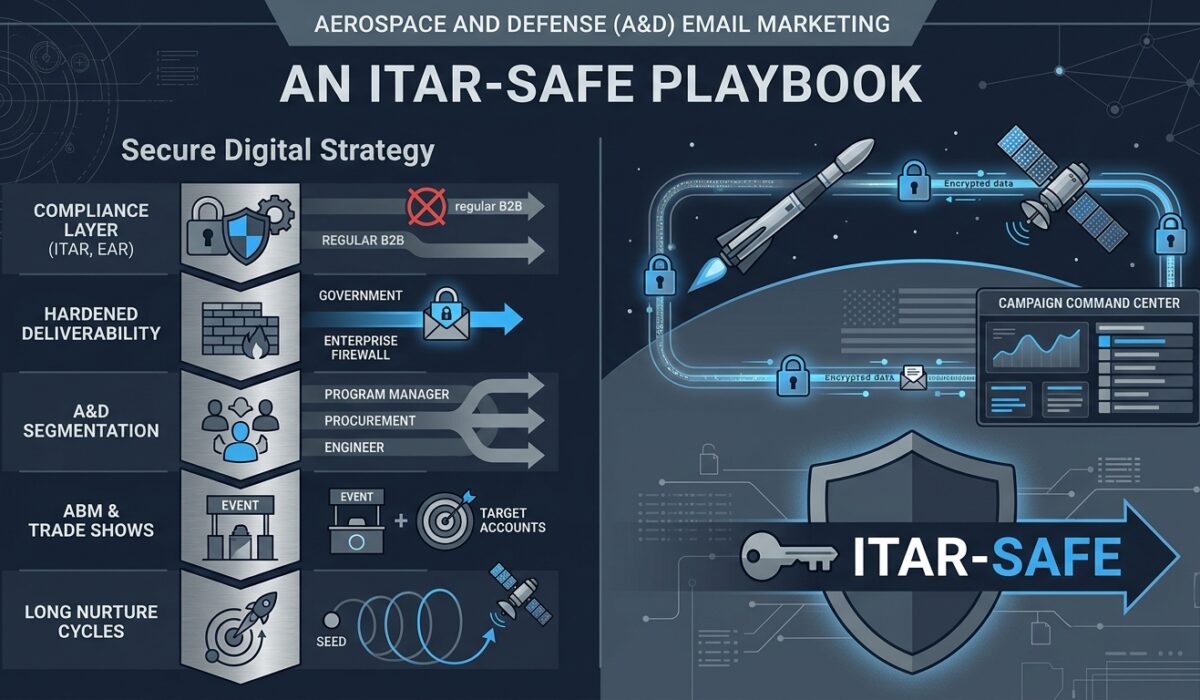
An email that would pass legal review at a consumer SaaS company can get a defense contractor’s marketing director called into a compliance meeting. That is the reality of aerospace and defense industry email marketing, and it is why generic B2B playbooks fail so often in this sector.
Quick Answer
Aerospace and defense industry email marketing works differently from standard B2B outreach because every message has to clear export-control screening (ITAR, EAR), cybersecurity requirements tied to DFARS and NIST SP 800-171, and inbox filters built for hardened government and prime-contractor networks. Effective programs segment by role (engineer, procurement officer, program manager, CISO), route technical content through a compliance or legal review step before send, and plan for buying cycles that run 12 to 36 months rather than weeks. The tools matter less than the process: a compliant, well-governed sequence in a standard platform beats a fast, ungoverned campaign in an expensive one.
Key Takeaways
- Compliance gates content, not just budget. Anything touching the U.S. Munitions List or dual-use technology needs a screening step before it reaches a send queue, regardless of which platform sends it.
- Deliverability depends on domain reputation and list hygiene more than platform choice. Government and prime-contractor mail gateways filter aggressively, and a burned sending domain can quietly kill a campaign for months.
- Buying committees, not individuals, decide. A single email sequence rarely works across an engineer, a procurement officer, and a program manager, so segmentation by role and clearance context matters more than open-rate optimization.
What Makes A&D Email Marketing Different From Other B2B Sectors
Most B2B email advice assumes a single decision-maker, a short sales cycle, and content that can say almost anything. None of that holds in aerospace and defense.
Defense spending crossed $2 trillion globally in 2024, and a growing share of that budget moves through digital research before a supplier ever gets a meeting. Roughly 70% of B2B buyers now research suppliers before engaging with sales. For a defense prime or a Tier 2 supplier, that research happens on a locked-down network, often behind a secure email gateway that was configured by a CISO who assumes every unfamiliar sender is hostile until proven otherwise.
The buying committee is also wider than a typical SaaS deal. A chief engineer cares about specifications and interoperability. A procurement officer cares about contract vehicles and past performance. A CISO cares about supply chain risk. A program manager cares about schedule risk. One newsletter template will not speak to all four at once, and trying to make it do so usually produces content so generic that none of them respond.
The Compliance Layer You Cannot Skip
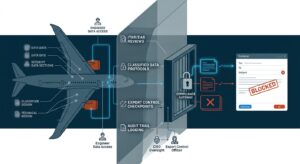
This is the part that trips up marketers who came from consumer or general SaaS backgrounds. Content in this sector is not just reviewed for tone. It is reviewed for what it is legally allowed to say.
Aerospace and defense marketing operates inside an export-controlled regulatory environment defined by ITAR, EAR, DFARS, and CMMC. ITAR governs technical data and defense articles tied to the U.S. Munitions List, and it applies even to information shared with a foreign national who happens to work inside a U.S. office. The regulation follows the item rather than the location, so a U.S. company remains responsible for compliance even when working with a foreign subcontractor or storing data overseas. A product spec sheet that mentions a controlled capability cannot go into a general nurture sequence without a screening pass, full stop. tabular
Email itself is a common failure point. A design file sent to a foreign national, or a technical specification forwarded to a vendor whose servers route through infrastructure abroad, can constitute a violation without any intent behind it. That is a marketing operations problem as much as a legal one: your CRM segmentation, your list-cleaning process, and your send workflow all need a checkpoint that asks whether a recipient’s citizenship or location changes what content they can legally receive.
On top of ITAR sits DFARS 252.204-7012 and NIST SP 800-171, which set cybersecurity controls for handling controlled unclassified information, and CMMC certification, which gates eligibility for many Department of Defense contracts. None of these regulations were written with marketing teams in mind, but marketing teams touch the systems they govern the moment a lead form, a CRM record, or an email attachment includes anything more sensitive than a press release.
The practical fix is not exotic. Build a short review checklist into the campaign workflow: does this content reference anything on the U.S. Munitions List or the Commerce Control List, does the recipient list include non-U.S. persons, and has legal or export-control staff signed off on the copy. A five-minute checklist step prevents a problem that can take months to unwind.
Deliverability Into Hardened Enterprise And Government Inboxes
Getting past a spam filter is hard enough for a normal company. Getting past a defense contractor’s mail gateway is harder, because those gateways are tuned by security teams who treat unfamiliar bulk senders as a threat category.
Domain reputation carries more weight here than almost anywhere else in B2B email. A cold domain sending its first campaign to a list of .mil and prime-contractor addresses will get throttled or blocked before a human ever opens the message. Warming a domain slowly, keeping bounce and complaint rates low, and authenticating with SPF, DKIM, and DMARC are not optional extras in this sector. They are the difference between a campaign that lands and one that never gets measured because it never arrived.
List hygiene matters just as much. Buying or scraping a defense-industry contact list is one of the fastest ways to burn a sending domain, because these networks flag unsolicited bulk mail quickly and share reputation signals across gateway providers. Building lists from trade show registrations, webinar sign-ups, and gated technical content earns a sender the benefit of the doubt that a purchased list never will.
Segmentation That Reflects How A&D Actually Buys
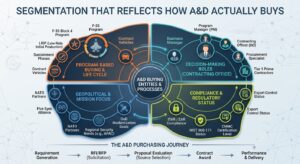
A useful rule for this sector: segment by role and by program stage, not just by industry vertical. An engineer wants specifications, interoperability data, and technical whitepapers. A procurement officer wants contract vehicle information, past performance data, and pricing structure. A program manager wants schedule and risk information. A CISO wants supply chain and cybersecurity posture.
Sending all four the same monthly newsletter wastes the list. Sending each of them a shorter, role-specific sequence, timed to where they sit in a 12 to 36 month buying cycle, produces far better engagement even at lower send volume.
Choosing A Sending Platform: What Actually Differs
| Approach | Primary Strength | Compliance Fit | Typical Cost Structure |
|---|---|---|---|
| FedRAMP-authorized government marketing platforms | Built for public-sector sending; pre-vetted security controls | Strongest fit for direct .gov/.mil distribution | Quote-based, contract procurement pricing |
| Enterprise marketing automation (Salesforce, HubSpot enterprise tier) | Deep CRM integration, strong segmentation and automation | Workable with added legal review layer; not defense-specific by default | Quote-based for enterprise tier, scales with contact volume |
| Dedicated ABM and account-based platforms | Strong for multi-stakeholder buying committees | Neutral; compliance depends entirely on your review process | Quote-based, often seat or account priced |
| Standard ESPs without enterprise controls | Low cost, fast setup | Weakest fit; lacks the audit trail most A&D legal teams want | Lower, often self-serve tiered pricing |
GovDelivery, now part of Granicus, holds FedRAMP certification at the moderate impact level, and its platform is already used by the Departments of Homeland Security, Defense, Veterans Affairs, and Health and Human Services. That certification is meaningful for agencies sending directly to citizens or internal government stakeholders, but most A&D suppliers marketing to primes and program offices will still run their campaigns through a standard enterprise ESP or marketing automation platform, layered with their own legal review step. The platform rarely decides whether a campaign is compliant. The process around it does.
Practitioner Tip
Build a “compliance hold” status into your CRM or marketing automation tool, separate from your normal approval workflow. Any email that references a program name, a specification, or a capability gets routed there first, and nothing in that status can be scheduled to send until a named reviewer clears it. Teams that skip this step almost always end up pulling a live campaign mid-send, which does more reputational damage than a delayed launch ever would.
Trade Shows, ABM, And Long Nurture Cycles

Trade shows like AUSA, SOF Week, and the Paris Air Show remain the backbone of A&D pipeline generation, and email is what keeps a badge scan from disappearing into a forgotten spreadsheet. A short, specific follow-up sequence, timed within 48 hours of the event and tied to the exact session or booth conversation a contact had, converts far better than a generic “great meeting you” template sent two weeks later.
Because these deals run for years rather than weeks, nurture sequences need a longer arc than most marketing teams are used to building. A quarterly cadence of technical content, paired with event-driven touches, keeps a supplier visible to a program office without crossing into the kind of frequent, sales-heavy messaging that gets flagged and unsubscribed by risk-averse government inboxes.
Common Mistakes That Stall A&D Email Campaigns
Three mistakes show up repeatedly in this sector. Marketing teams send technical detail before legal has cleared it, which creates real export-control exposure rather than just a bad look. Teams treat a purchased or scraped contact list as a shortcut, which damages domain reputation for every future campaign, not just the one it was used for. Teams also apply consumer cadence, several emails a week, to an audience that expects quarterly or monthly contact and will unsubscribe fast when treated like a retail customer.
Each of these is fixable with process, not budget. A short compliance checklist, a list-building discipline built on opt-in sources, and a cadence matched to a multi-year buying cycle solve most of what goes wrong.
A Practical Rollout Checklist
Start with a compliance checkpoint built into the send workflow before a single campaign goes live. Add domain warming and authentication before sending to any hardened network, even a small one. Build role-based segments before writing content, not after. Set cadence expectations around the actual buying cycle length rather than a generic monthly calendar. Review every campaign against export-control criteria, not just brand tone, before it reaches a scheduling queue.
FAQs
Does every aerospace and defense email need legal review?
Not every email, but any email referencing a program, specification, or capability that could touch the U.S. Munitions List or the Commerce Control List should pass a review step before it sends.
Why do A&D emails get blocked even when they are not spam?
Government and prime-contractor mail gateways are tuned aggressively, and domain reputation, authentication, and list hygiene matter more here than almost anywhere else in B2B email.
How long should a nurture sequence run for this sector?
Plan around the actual buying cycle, typically 12 to 36 months, with quarterly technical touches supplemented by event-driven follow-ups rather than a weekly cadence.